

A roulette table makes a small bet look like a big decision. A chip on one number promises a large payout; a chip on red seems to win almost half the time. Which is better? Understanding roulette odds means separating your chance of winning from what the game pays when you do. Those figures answer different questions.
DefiPlay is a blockchain casino whose European roulette uses Polygon transactions and Chainlink VRF for random numbers. Its open-source contracts and public transaction records let players inspect how a result was produced. That visibility matters, but it doesn't remove a game's mathematical edge. The DefiPlay European roulette overview explains the on-chain approach; the table below describes standard European rules, rather than a verified DefiPlay-specific payout schedule.
European roulette odds and payout table
Say you place a chip on the first dozen because twelve numbers sound like plenty of coverage. You still need the denominator: twelve out of how many? Wikipedia's Roulette article (accessed 2026) describes the standard European model as 37 equally likely pockets, numbered 0 through 36.1 Every probability below uses that model.
The New Jersey Division of Gaming Enforcement's roulette rules (accessed 2026), section 13:69F-5.2(a), list straight bets at 35 to 1, splits at 17 to 1, and the other standard payout ratios shown here.2 These are profit payouts. Your winning stake comes back as well.
| Bet | Numbers covered | Chance of winning | Profit payout | Total returned on a winning 1-unit bet |
|---|---|---|---|---|
| Straight-up | 1 | 1/37 = 2.70% | 35:1 | 36 units |
| Split | 2 | 2/37 = 5.41% | 17:1 | 18 units |
| Street | 3 | 3/37 = 8.11% | 11:1 | 12 units |
| Corner | 4 | 4/37 = 10.81% | 8:1 | 9 units |
| Six line / double street | 6 | 6/37 = 16.22% | 5:1 | 6 units |
| Dozen | 12 | 12/37 = 32.43% | 2:1 | 3 units |
| Column | 12 | 12/37 = 32.43% | 2:1 | 3 units |
| Even-money | 18 | 18/37 = 48.65% | 1:1 | 2 units |
Percentages are calculated from the exact fractions and rounded to two decimal places. Every listed bet has a 2.70% house edge under standard single-zero rules, with no special zero treatment. We'll show why below.
A straight-up bet covers one number, including zero if you choose it. A split covers two adjoining numbers on the betting layout. A street covers a row, such as 1, 2 and 3. A corner covers a block, such as 1, 2, 4 and 5; a six line covers two adjacent rows.
A dozen covers 1–12, 13–24 or 25–36. A column covers one vertical column of twelve numbers. Even-money bets include red/black, odd/even and low/high, meaning 1–18 or 19–36. Zero belongs to none of those outside groups.
Coverage follows the betting layout, not a guess about neighbouring pockets on the wheel. The roulette rules and chip-placement guide helps you match a chip position to the numbers you intend to cover.

A payout is profit; a return includes your stake
A payout label can make your wallet balance look confusing. Say you stake 10 units on one number and it wins: does “35:1” mean you receive 350 units or 360? Under the standard convention, you receive 350 units of profit plus your 10-unit stake. The total return is 360 units.
The University of Nebraska's Contemporary Mathematics lesson on expected value (accessed 2026) uses an American roulette example to make the same distinction: a winning $1 single-number bet returns $36, consisting of the original dollar plus $35 in profit.3 The payout convention is the same here, although our European probabilities use 37 pockets rather than its 38.
You can read any row of the table that way. A 10-unit dozen bet makes 20 units of profit and returns 30 units in total if it wins. If it loses, the full 10 units are gone. A winning return isn't all new money.
There's another distinction hiding in roulette odds: true odds and offered payouts. A straight-up bet has 36 losing pockets for every winning pocket, so its true odds against winning are 36:1. But the game pays only 35:1 in profit. That shortfall creates the house advantage.
For a clean comparison, you can record three figures separately: amount staked, amount returned and net profit or loss. On-chain settlement doesn't change those definitions. Transaction fees are a separate expense, so a wallet balance change may also include costs outside the wager itself.
Every standard bet loses the same fraction on average
Frequent wins can feel like better value. Imagine two adults each wagering $10 per round: one chooses red, the other chooses a single number. Red wins much more often. Yet both bets have the same expected game loss per dollar staked under the rules above.
Expected value, or EV, is the probability-weighted average of the possible net outcomes. It isn't a prediction of your next result. Nebraska's lesson defines it by multiplying each outcome by its probability and adding the products.3
Here's the working for a $10 red bet:
- A win has probability 18/37 and produces a net gain of $10.
- A loss has probability 19/37 and produces a net loss of $10, including when zero appears.
- EV = (18/37 × $10) + (19/37 × −$10) = −$10/37 ≈ −$0.27027 per bet.
Divide that expected loss by the $10 stake and you get 1/37, or approximately 2.70%. Wikipedia's roulette reference (accessed 2026) gives the same 1/37 expected loss for a standard European single-number wager.1
The common pattern is easier to see using total returns. A bet covering k numbers wins with probability k/37, while its winning return is 36/k times the stake. Those factors cancel to an average gross return of 36/37 of the stake. The missing 1/37 is the edge, regardless of the coverage.
So changing from a split to a column changes the distribution of outcomes, not that average cost. The house-edge explanation covers how the percentage relates to total wagering. It doesn't mean you'll lose exactly 2.70% of your starting balance during a particular session.
More frequent wins come with smaller bankroll swings
Say you set aside 100 units and make 1-unit bets. With straight-up wagers, you can lose repeatedly and then receive one large return. Red or black produces smaller changes more frequently. The average loss is equal, but the experience isn't.
Variance measures how widely net outcomes spread around their average. Standard deviation is the square root of variance, expressed in the same units as the stake. A larger value means greater spread; it doesn't mean better odds or a promised result.
Calculated from the two possible net outcomes of each standard bet, a 1-unit straight-up wager has a one-spin standard deviation of approximately 5.84 units. An even-money wager has approximately 1.00 unit. A dozen and a column both have approximately 1.40 units, because their coverage and payouts match.
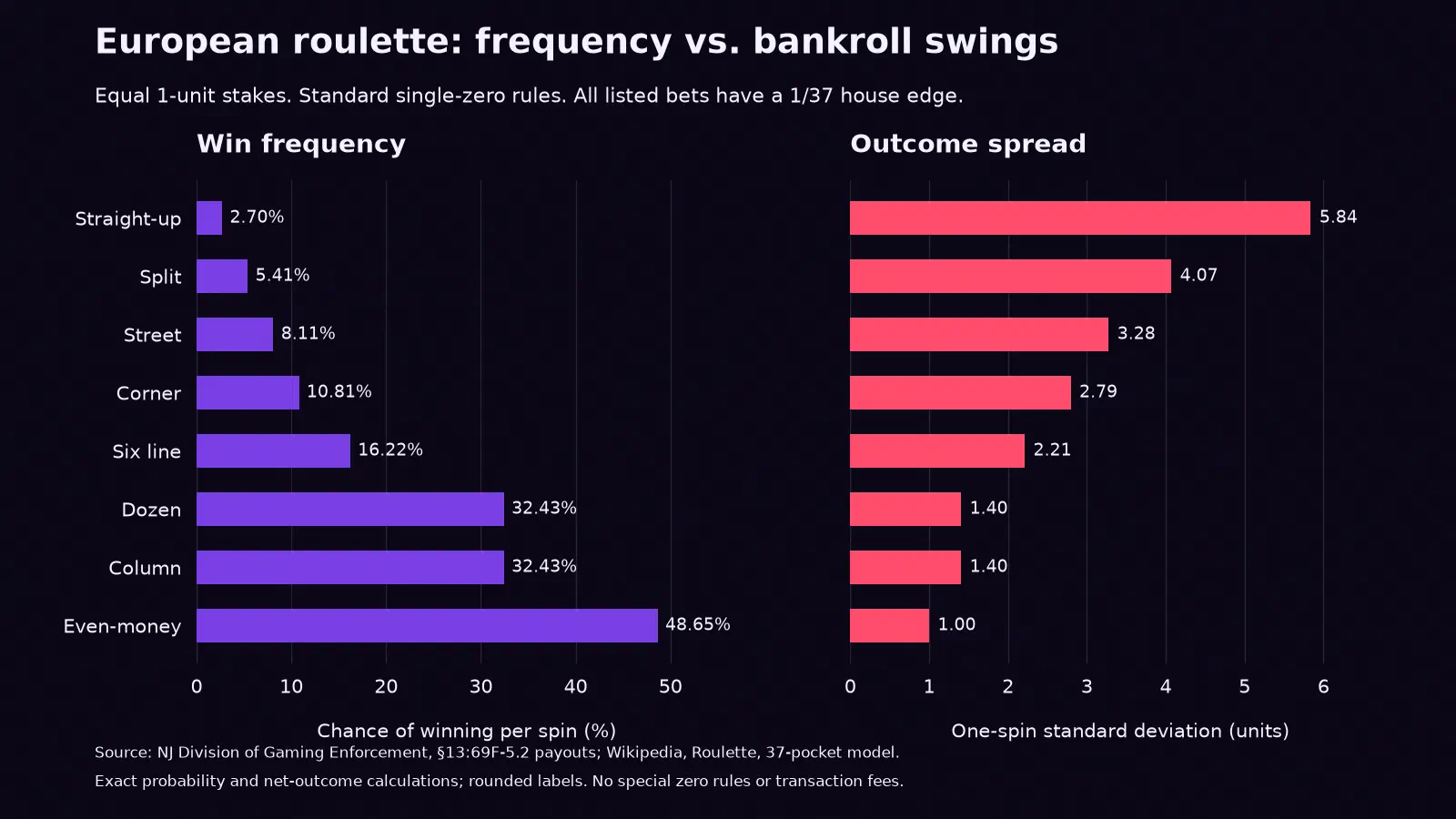
The chart keeps the stake fixed so the comparison means something. A 10-unit red bet can produce a larger cash swing than a 1-unit straight-up bet. Changing bet size changes the cash risk too.
If you prefer smaller jumps, even-money bets are lower-variance choices at equal stakes. But they aren't protection against a losing session. Your maximum loss on any one listed wager is still the amount staked, and a sequence of losses can exhaust a budget. Choosing a quieter pattern is a preference, not a method for beating the house.
Thirty-seven spins don't guarantee one hit
A probability of 1/37 can sound like a timetable. Say you back the same number for 37 independent spins and expect it to appear once. It might appear more often, or never. An average frequency isn't a delivery schedule.
Under the fair, independent model, the chance that your selected number misses all 37 spins is (36/37)^37 ≈ 36.29%. That's a substantial possibility, even though the expected number of hits over those spins is one. The next spin still gives that number a 1/37 chance; previous misses don't make it due.
You can use expected loss for a different purpose: understanding the cost of repeated wagering. Suppose your total stakes add up to $1,000 under standard European rules. The expected game loss is $1,000/37 ≈ $27.03, before transaction fees. That total can include money you've won and wagered again; it isn't necessarily $1,000 brought to the table.
Your actual result can sit far from that average. One win can put you ahead; a dry run can cost much more. This is why a spending limit needs to reflect what you can afford to lose, rather than an EV estimate treated as a cap.
Increasing stakes after misses increases the money exposed. It doesn't improve the next result's probability. The Martingale strategy analysis explains the escalating-stake problem without treating it as a winning system. For practical limits and support, see responsible gambling guidance.

A special zero rule changes the calculation
A table labelled “European” may need another question. Say red loses only half your stake when zero appears. That bet no longer follows our standard table's full-loss rule, so applying the same edge without checking would be wrong.
Wikipedia's roulette reference (accessed 2026) describes la partage as returning half an eligible even-money wager when zero lands.1 With full wins and losses balancing across the 18 red and 18 black pockets, the remaining expected loss comes from losing half a stake on the single zero. The resulting edge is 1/74 ≈ 1.35% on eligible even-money bets. It doesn't reduce the edge on ordinary straight-up or dozen bets.
The standard case is different. New Jersey's roulette rules (accessed 2026), section 13:69F-5.2(c), explicitly make single-zero red/black and other even-money wagers lose when zero appears.2
You can compare a game's written zero rule and payout schedule before using any odds table. A different pocket count also changes the calculation; the European versus American roulette comparison covers that distinction. Don't assume a named variant promises a particular exception.
Bet choice changes the swings, not the standard edge
A visible result can still be misread. Say you verify an on-chain random outcome and see that your wager settled as specified. You've checked part of the game's operation; you haven't turned a negative-EV payout schedule into a positive one.
The guide to provably fair games explains verification, while the crypto casino overview explains wallet-based play. For this table, the conditions remain a uniform 37-pocket result and the stated standard payouts.
You can read roulette odds with two separate decisions in mind: which outcome pattern you prefer, and how much money you're prepared to expose. No listed standard bet has a mathematical discount. Smaller stakes and less total wagering reduce expected game losses; switching to a bet that wins more often doesn't.
Frequently asked questions
What are the odds of winning on European roulette?
A single-number bet wins with probability 1/37, or 2.70%. An even-money bet such as red wins with probability 18/37, or 48.65%. Other standard bets fall between those probabilities according to how many pockets they cover.
Does roulette pay 35 to 1 or 36 to 1?
A standard straight-up bet pays 35 to 1 in profit, with your winning stake returned separately. A winning 1-unit bet therefore returns 36 units in total. On European roulette, the true odds against that single number winning are 36 to 1.
Which European roulette bet has the lowest house edge?
Under standard single-zero rules, all the bets in this table have the same house edge of 1/37, or about 2.70%. Even-money bets win more often but pay less. A stated la partage rule reduces the edge on eligible even-money bets to about 1.35%.
Is red or black a 50 percent chance in roulette?
No. A European wheel has 18 red pockets, 18 black pockets and one zero, so either colour wins with probability 18/37, or about 48.65%. Under standard rules, zero loses for both red and black bets.