

The martingale strategy promises a tidy recovery: double your roulette stake after a loss, then let one win pay back everything. The problem appears when that win takes longer than your wallet or the table allows. A $1 opening bet can turn into a $128 decision within the same losing run.
You can calculate that exposure before putting money at risk. The useful questions are how many bets you can fund, what stops the next doubling, and how much each transaction costs. None of those calculations turns roulette into a profitable game.
DefiPlay is a blockchain casino whose European roulette game uses Chainlink VRF for random numbers and records each bet as a public blockchain transaction on Polygon. Players use their own wallets. That crypto casino model makes transaction costs relevant to a betting progression; verifiable randomness doesn't change its arithmetic. Our Chainlink VRF explanation covers the randomness mechanism separately.
How the martingale strategy works on even-money bets
A recovery win can look more impressive than it is. Say you lose $1, then $2, then $4 on red, before winning an $8 bet. Your earlier stake losses total $7. The winning bet produces $8 of profit, so your net gain for the sequence is $8 − $7 = $1, before transaction fees.
The $8 winning stake is also returned. That makes the total payout $16, but counting all $16 as profit would double-count your own money. This distinction matters when you compare a game's payout display with your wallet balance.
An even-money bet pays a profit equal to the stake when it wins. Red or black, odd or even, and low or high fit this model under standard roulette rules. You begin with a base stake, double after a loss, and reset to the base after a win. We'll call that sequence a cycle: it ends at the first win or when your permitted bets run out.
Peter Pflaumer's 2019 statistical paper, hosted by UNLV, analyzes this same one-unit recovery and the finite limits that can prevent it. A successful cycle earns one base unit, regardless of how many losses preceded the win. The larger stakes don't buy a larger recovery profit.
These examples assume a fair single-zero wheel with independent outcomes and a full loss on zero. They don't apply unchanged to special zero rules such as la partage, which returns half an even-money stake on zero. You can check the betting categories in our roulette rules guide.

Your bankroll must fund the whole sequence
A small opener hides a large funding requirement. With a $1 base stake, the first eight bets are $1, $2, $4, $8, $16, $32, $64 and $128. Having $128 available at the start isn't enough to reach the eighth bet: you must also pay for every preceding loss.
For a base stake b, the stake on bet k is b × 2^(k−1). Funding n bets requires the geometric sum:
B_required = b × (1 + 2 + ... + 2^(n−1)) = b × (2^n − 1)
At eight bets and a $1 base, that becomes $1 × (2^8 − 1) = $255. The largest individual stake is $1 × 2^7 = $128. These are different constraints: one concerns cumulative spending, the other a single accepted wager.
The chart shows both. All dollar amounts are illustrative accounting units, not DefiPlay minimum bets, accepted currencies or table limits. Fees are excluded here so you can see the stake requirement clearly.
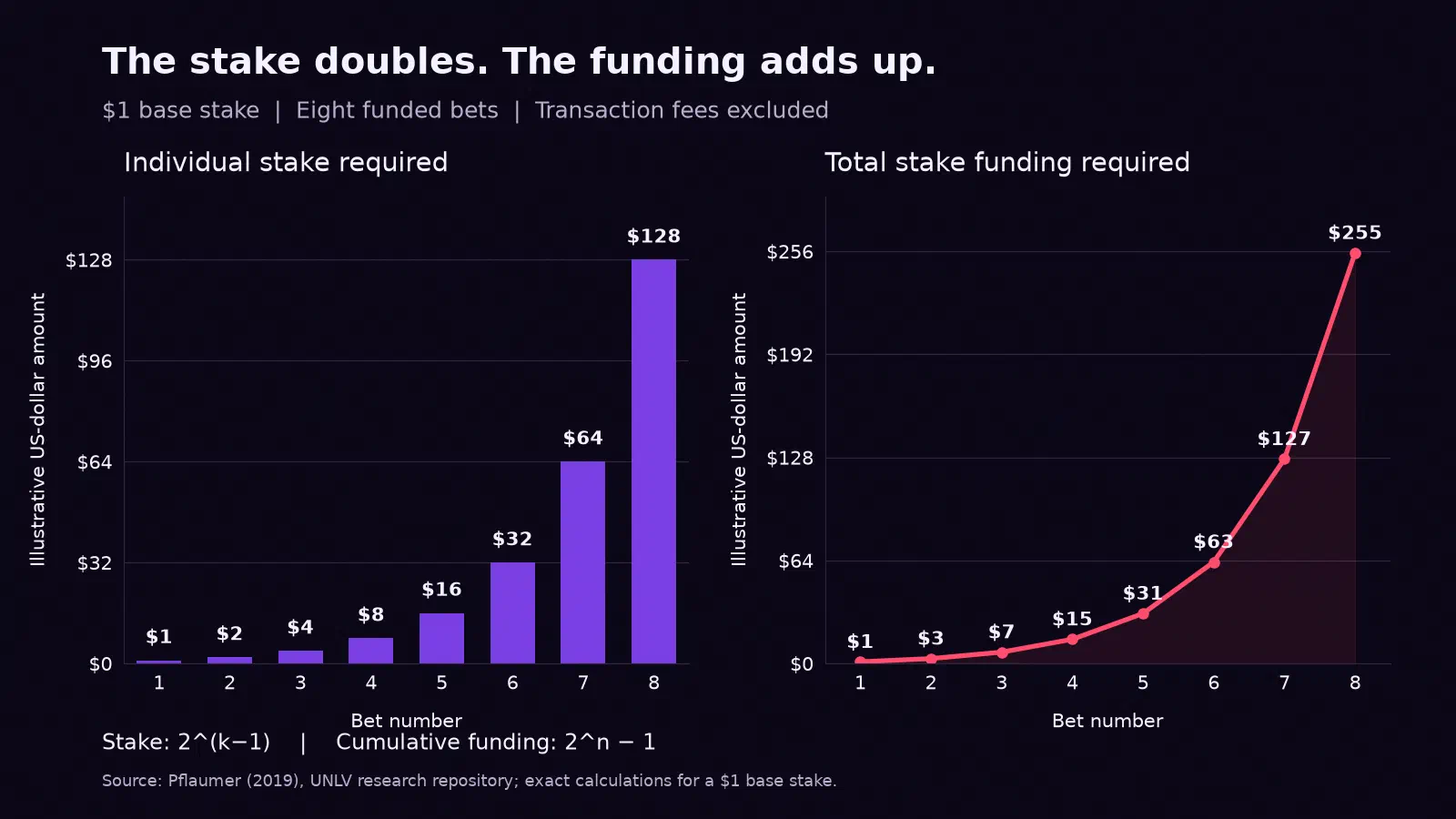
There's an easy counting mistake here. Funding eight bets means you can lose eight bets and then stop. It doesn't mean you can lose eight and still place a recovery bet. That ninth stake would be $256, bringing the total funding requirement to $511.
A practical exposure check therefore starts with the largest loss sequence you're assessing, rather than the smallest bet you like. The doubling rule makes the final wager the biggest demand on your budget, precisely after the earlier wagers have depleted it.
A table limit can stop you before your money runs out
A wallet balance can suggest you have room to continue when the betting rules say otherwise. Suppose you have $255 reserved for stakes, a $1 base bet, and an illustrative $100 maximum on the chosen even-money bet. The $64 seventh bet is allowed. The $128 eighth bet isn't.
After seven losses, you've spent $127 and still have $128. Your wallet isn't empty, but the intended recovery sequence has ended. Calling this situation “bankruptcy” would be misleading; the table limit has blocked the next stake.
The usable number of bets is the largest whole number n satisfying both conditions:
b × (2^n − 1) ≤ B
b × 2^(n−1) ≤ L
Here B is your stake budget, excluding gas, and L is the maximum permitted stake on that bet. In the example, the budget supports eight bets but the limit supports only seven. The smaller count governs the cycle.
Reducing the next wager to $100 doesn't preserve the original recovery promise. After losing $127, a $100 win would still leave a $27 stake loss. Changing colors doesn't solve the limit either. The next independent red or black bet has the same odds.
If you're assessing any progression, the relevant maximum is the limit for the actual bet you're considering. An unrelated game's limit, or a maximum for another betting category, won't tell you whether your next stake can be accepted.
Losing-streak odds apply to one defined cycle
A rare event can feel irrelevant after a string of small wins. For the eight-bet example, most cycles finish with that $1 stake profit. But the probability needs a denominator: are you asking about one cycle, or repeated attempts across a session?
Wikipedia's roulette reference, consulted in 2026, describes a European wheel with 37 pockets, including 18 red, 18 black and one zero. A standard bet on red therefore wins with probability 18/37 and loses with probability 19/37. Zero belongs in the losing count.
For independent spins, the chance of n consecutive losses from the start of a cycle is:
P(all n bets lose) = (19/37)^n
Eight losses give (19/37)^8 ≈ 0.4835%. So an eight-bet cycle succeeds about 99.5165% of the time, before fees. Ten losses have probability about 0.1275%, but funding those ten bets requires $1,023 at a $1 base, with a $512 final stake.
These probabilities don't make a later win “due.” After seven losses, the next red bet still has a win probability of 18/37, under the model. Past results don't rebalance the next spin.
Repeated cycles create repeated exposure. In a hypothetical set of 100 independent, fully funded eight-bet cycles, the probability of at least one failed cycle is 1 − [1 − (19/37)^8]^100 ≈ 38.41%. That calculation assumes each cycle starts with enough money for the same eight-bet depth. It isn't a forecast for one unreplenished wallet, and it isn't the probability of an eight-loss streak somewhere in 100 spins.
This is why a “99.5% success rate” needs context. Our roulette odds explanation covers individual bets; a progression adds a separate question about how many opportunities you give a losing run to exhaust your permitted stakes.
Frequent winning cycles still have negative expected value
A screen full of winning cycles can conceal a losing average. In the eight-bet example, a successful cycle earns $1, while a failed cycle loses $255. The result is highly uneven: the occasional large loss outweighs the many small gains in expectation.
Expected value, or EV, is the probability-weighted average result across repetitions of the same conditions. Let q = 19/37. The eight-bet calculation is:
EV = (1 − q^8) × $1 + q^8 × (−$255)
EV = $1 − $256 × (19/37)^8 ≈ −$0.2378 per cycle
That's an expected loss of about 24 cents before gas, despite the high chance of a $1-winning cycle. It doesn't predict the result of your next attempt. You may win it; the unfavorable average remains.
Pflaumer's 2019 paper gives the general expression b × [1 − (2q)^n]. It reports approximately −0.3056 units for a ten-bet cycle with a one-unit base. Since 2q = 38/37, the bracket is negative for every positive finite number of bets.
You can also see the reason at the individual-wager level. A $1 even-money stake has EV (18/37 × $1) − (19/37 × $1) = −$1/37, or a 2.70% house edge. Doubling scales the amount exposed to that disadvantage. It doesn't change the payout or the probabilities.
The percentage applies to money wagered, including repeat wagers, rather than automatically to your starting wallet balance. Our house edge guide explains that distinction. The martingale strategy changes the pattern of gains and losses; it leaves expected returns negative.
Gas fees reduce even the winning cycles
A $1 recovery profit isn't necessarily a $1 wallet gain on-chain. Say each bet costs an illustrative $0.02 in gas, and token prices stay constant during the calculation. If you win on the fourth bet, four fees total $0.08. The $1 stake profit becomes $0.92 after gas.
A win on the eighth bet leaves $0.84 after eight fees totaling $0.16. Losing all eight costs $255 in stakes plus $0.16 in gas. The doubling sequence recovers earlier stake losses on a win, but it doesn't recover those transaction fees.
EIP-1559, created in 2019, specifies Ethereum's fee accounting: gas used is charged at the effective gas price, which combines the base fee and the effective priority fee. Its intrinsic transaction cost starts at 21,000 gas before calldata and other costs. That starting figure isn't a gas estimate for a roulette smart-contract call.
For a real cost check, use the transaction's actual fee in the network's native token and keep it separate from the wager. Wallet estimates and token prices can change. The $0.02 assumption here is a worked example, not a current Polygon price or a DefiPlay fee quote.

Not every cycle uses all eight bets. Its expected number of bets is 1 + q + ... + q^7 ≈ 2.0456. At the assumed fee, expected gas spending is about $0.0409 per cycle. Adding that to the stake EV gives an all-in expectation of approximately −$0.2787 per cycle.
The maximum funding check still needs the full eight-fee reserve: $255.16 under these assumptions. A wallet with exactly $255 available for both stakes and fees can't fund the entire sequence. Our Polygon gas fees guide covers fee accounting in more detail.
A fixed loss budget is more useful than a doubling rule
The hardest decision often arrives after the money has already gone. In our example, seven losses can make a $128 wager feel necessary because stopping would leave $127 unrecovered. That feeling doesn't improve the next bet's odds. It only changes how much you're willing to lose.
A loss budget set before play gives you a stopping point that doesn't depend on recovering earlier wagers. Treat it as money you can afford to lose, with transaction costs included. A fixed stake avoids compulsory escalation after losses, although it still has negative expected value and can exhaust your budget.
If you find yourself adding funds to keep a progression alive, pausing is more useful than extending the stake sequence. Our responsible gambling guidance is a place to start. A blockchain record can help you inspect what happened; it can't make the next spin repay the previous ones. Doubling buys a larger wager, never a better probability.
Frequently asked questions
What is the martingale strategy in roulette?
You start with a base stake on an even-money bet, double after each loss, and return to the base stake after a win. A win recovers earlier stake losses plus one base unit, before fees. A finite bankroll or table limit can stop the progression before that win arrives.
How much bankroll do you need for eight Martingale bets?
With a $1 base stake, eight bets require $255 in total stake funding and a maximum permitted bet of at least $128. Losing all eight consumes that $255. Placing a ninth bet would require another $256, so the total funding would rise to $511, before fees.
What is the chance of eight losses in European roulette?
On a fair single-zero wheel, an even-money bet has a loss probability of 19/37 when zero loses the full stake. Eight independent losses have probability (19/37)^8, approximately 0.4835%. That is a per-cycle probability, not the chance of encountering the streak anywhere in a long session.
Does Martingale work better in a blockchain casino?
Recording bets on a blockchain does not change the roulette payout or house edge. Transaction fees create an extra cost beyond stake losses. With an illustrative $0.02 fee per bet, an eight-bet winning cycle earns $0.84 rather than $1.