

A small percentage can hide a surprisingly large spending rate. Say you bet $5 while waiting for dinner: your starting balance tells you little about how much money you've put through the game. The same dollars can be wagered repeatedly. Understanding house edge lets you turn a game's rules into an expected cost, then adjust that estimate for your stake, playing pace and transaction fees. It won't tell you what tonight's session will return.
DefiPlay is a blockchain casino with European roulette and crypto slots built on Polygon. Each bet or spin is processed and recorded on a public blockchain, and its games use Chainlink VRF for verifiable random numbers. That makes the distinction useful: checking how a result was produced doesn't change the payout mathematics. The DefiPlay European roulette page explains the game context; here, we'll separate its standard mathematical model from network spending. None of the slot figures below describes DefiPlay's payout settings.
What does house edge measure?
A winning bet can look generous while still offering an unfavourable average return. For example, a single-number roulette win pays much more than your stake, but that payout must be weighed against all the losing outcomes.
Wikipedia's Casino game entry (2026) defines house edge as expected casino profit expressed as a percentage of the player's original bet. The UK Gambling Commission's RTP guidance (2021) describes the same measure as the percentage a casino expects to keep, on average, given normal patterns of play. The word “expected” matters: this is a probability-weighted average, not a deduction taken from every win.
For a fixed stake, the general calculation is:
Expected net result = sum of each outcome's probability × its net profit or loss.
Casino advantage (%) = −expected net result ÷ stake × 100.
Your net result excludes the returned stake. If a $1 wager returns $2 in total, you've made $1 profit. If it returns nothing, you've lost $1. Mixing gross returns with net profit is an easy way to produce the wrong answer.
Keeping those definitions consistent lets you compare payouts honestly. You'll find the original-stake convention in Wikipedia's casino-game explanation (2026); games with extra wagers during a hand need care because their final stakes may differ from the initial bet.
Roulette: the zero changes the average return
Red and black look like equal choices, so a player might expect an even-money wager to break even. The missing detail is zero: it's neither colour, and under ordinary rules it loses your red bet.
Wikipedia's Roulette entry (2026) reports 37 pockets for single-zero European roulette and 38 for double-zero American roulette. Each has 18 red numbers and 18 black numbers. Red pays 1:1 in net winnings. These examples assume equally likely pockets, standard payouts and no special zero rule.
Take a $1 European bet on red. You win $1 profit with probability 18/37 and lose $1 with probability 19/37:
Expected net result = (18/37 × $1) + (19/37 × −$1) = −$1/37.
Casino advantage = ($1/37) ÷ $1 × 100 = 2.702702…%, rounded to 2.70%.
On an American wheel, the extra zero makes the losing probability 20/38. The same calculation becomes 18/38 − 20/38 = −2/38, giving 5.263157…%, rounded to 5.26%. Those are the percentages Wikipedia reports for standard wagers.
A single-number European bet gives the same average: its 35:1 net payout must cover a 1/37 winning probability and a 36/37 losing probability. Choosing red instead changes how often you win and how large the wins are; it doesn't remove the mathematical disadvantage.
Checking the wheel and payout rules is more useful than watching a colour streak. Special zero rules and the American five-number bet need separate calculations. Our roulette odds guide covers the bet-by-bet probabilities, while the roulette rules page explains the basic wagers.

A simple slot example: count every possible return
A slot can offer frequent prizes without returning most of what you stake. Say its paytable shows several winning symbols: the pictures don't tell you how likely those prizes are. You need both probabilities and payouts.
Here's a deliberately simplified teaching slot, not a real game's specification. Each $1 spin independently selects one of 100 equally likely outcomes:
- Five outcomes return $10 each, including the stake.
- Twenty outcomes return $2 each, including the stake.
- Seventy-five outcomes return $0.
The expected total return is (5/100 × $10) + (20/100 × $2) + (75/100 × $0) = $0.90. Subtract the $1 stake and the expected net result is −$0.10. This toy game therefore has 90% return to player, or RTP, and a 10% casino advantage.
For a fixed-stake game on a consistent accounting basis, the relationship is advantage = 100% − RTP. Don't subtract a prize's net profit from 100%; RTP uses total money returned, including any stake returned with a win.
The Gambling Commission's guidance (2021) gives an 85% RTP example and warns that this doesn't promise 85 pence back per £1 during one playing session. The same warning applies to our hypothetical 90% slot. Its largest prize might fail to appear in your session, or several could arrive close together.
For an actual slot, a payout list alone won't establish RTP if outcome weights aren't disclosed. You'd need the stated return and its assumptions, or enough verified probability data to calculate it. The DefiPlay crypto slots page gives the game's context; our slot-machine mechanics article explains why symbol frequency matters.
Expected loss per hour starts with total wagers
A low percentage can still be expensive at a fast pace. Say a hypothetical player stakes $5 per round and completes 120 rounds in an hour. That's $600 wagered, even if their starting wallet balance was much smaller and they reused winnings.
For constant stakes and a fixed edge, the estimate is:
Expected game loss per hour = stake per round × rounds per hour × advantage as a decimal.
Using the exact European roulette fraction gives $5 × 120 × 1/37 = $16.216216…, or $16.22. The equivalent American calculation is $5 × 120 × 2/38 = $31.578947…, or $31.58. Our hypothetical slot would give $5 × 120 × 0.10 = $60.
These are calculated illustrations, not measured player results or DefiPlay speed claims. Using the exact fraction also avoids a rounding shortcut: 2.70% is a display value, while 1/37 is the model's exact rate.
Pace deserves as much attention as the percentage. At $5 and 60 completed rounds, the European expectation becomes $300/37 = $8.11, rounded. Halving the number of wagers halves the expected game loss because the total amount exposed to the same disadvantage has halved.
If you change stake sizes, count the actual wagers rather than multiplying your largest bet by the whole session. Under the same fixed rules, expected loss is the edge multiplied by their total. If different bets have different edges, calculate each separately and add them.
Your planned round count isn't guaranteed either: you may stop early or run out of funds. This is a planning estimate for the stated amount of play, not a forecast that assumes your wallet can keep funding bets indefinitely.
Compare the bet and rules, not just the game name
A headline such as “baccarat has a low edge” leaves a practical question unanswered: which wager? The same game can contain bets with different expected costs, and commission changes the payout you actually receive.
Wikipedia's Baccarat entry (2026) reports 1.06% for the standard Banker bet, including a 5% commission on winning profit, and 1.24% for the Player bet. The chart compares these reported figures with ordinary single-zero and double-zero roulette. It excludes network fees and special roulette zero rules.
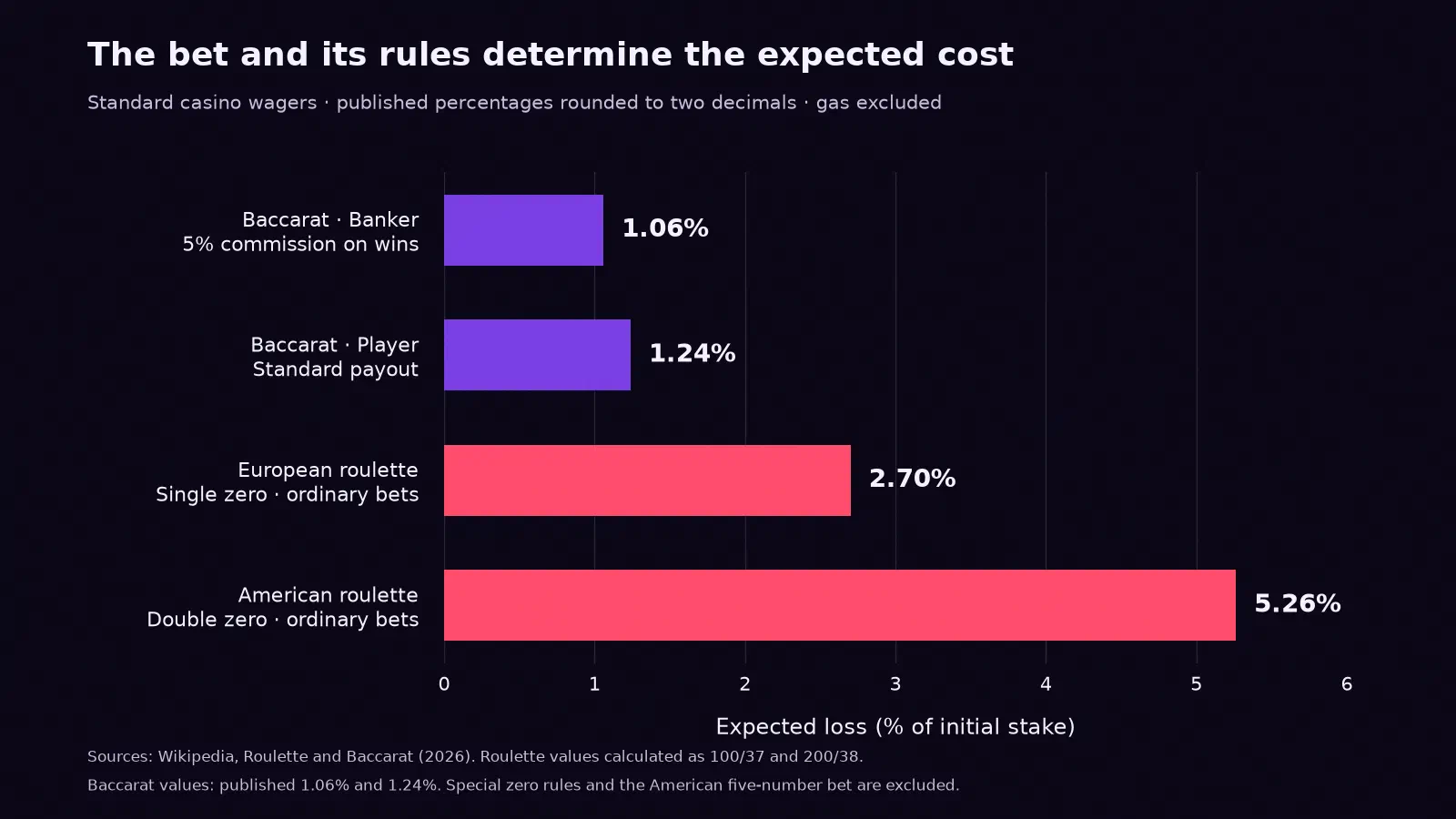
These bars show expected loss per dollar initially wagered, not your chance of losing a session. A smaller bar doesn't establish a safe stake size. Nor does it promise a smoother sequence of results.
There's deliberately no generic slot bar. Our teaching paytable has a calculated return, but presenting it beside sourced real-game figures could imply that slots share that percentage. They don't share a universal paytable. For any game, the useful comparison names the wager, payout rules and accounting basis before it names the percentage.
On-chain gas adds a separate cost
A tiny wager can make a small transaction fee look large. Say a hypothetical on-chain round costs $0.02 in fees: that amount is modest next to a $5 bet, but significant beside a $0.10 bet. The fee doesn't care whether the spin wins.
The Ethereum Foundation's gas documentation (2026) defines gas as a measure of computational effort. Its example uses 21,000 gas × (10 + 2) gwei = 252,000 gwei = 0.000252 ETH for a simple Ethereum transfer. That's an illustration of Ethereum fee arithmetic, not a Polygon casino fee estimate. A game contract performs different work.
EIP-1559 (2019) specifies the fee structure: gas used multiplied by the effective gas price, comprising the base fee and actual priority fee. For your own budget, the wallet estimate and final transaction receipt matter more than borrowing somebody else's transfer example.
Extend the hourly model by adding the total fees you pay. If our hypothetical 120-round session requires one player-paid transaction per round at $0.02 each, fees add 120 × $0.02 = $2.40. Combined with European roulette's expected game loss, the estimate becomes $16.216216… + $2.40 = $18.62, rounded.
At that assumed price, fees alone equal 0.4% of a $5 stake, but 20% of a $0.10 stake. That comparison explains why the fee-to-stake ratio matters. It isn't a reason to increase your bet: larger wagers also increase the amount exposed to the game's disadvantage.
Use a common currency when adding stakes and fees, and state the conversion rate if different tokens are involved. Count any other player-paid transactions separately. The Ethereum documentation also explains that failed execution can still consume gas; a transaction rejected before inclusion is different.
The crypto casino overview explains DefiPlay's wallet-based approach. Our Polygon gas fees guide covers network spending without treating it as part of a game's published RTP.

A verified result can still cost more than your budget allows
A public transaction can explain a result without making the next wager affordable. Say you've already lost your entertainment budget but the average-loss calculation looks smaller: that doesn't mean the game owes you the difference.
The Gambling Commission's guidance (2021) says a random machine's current winning odds aren't changed by previous wins or losses. That statement concerns random machines, not every machine design. For the independent teaching slot above, a losing run therefore doesn't create a compensating prize due on the next spin.
Likewise, changing stake sizes on ordinary roulette doesn't change its pocket probabilities or payout ratio. No progression turns that negative expectation into a winning system. The provably fair explanation addresses verification; your spending boundary addresses what you can afford to lose.
The useful conclusion is specific: house edge turns total wagers into expected game loss; player-paid transaction fees add another cost. Set an affordable loss limit separately from that expectation, because actual losses can exceed the average. If you find yourself playing to recover money rather than for entertainment, the responsible gambling page is the better next step than another calculation.
Frequently asked questions
What does house edge mean?
It is the casino's expected profit as a percentage of your initial stake under the stated rules. A 2.70% advantage means an expected loss of about $2.70 per $100 wagered across repeated play. It does not predict the result of one session.
How do you calculate the casino's advantage?
Multiply each possible net result by its probability and add those values to find your expected net result. Divide the negative of that result by the stake, then multiply by 100 to express the casino's advantage as a percentage. Returned stakes belong in total returns, but not in net profit.
What is the difference between RTP and the casino's edge?
RTP is the expected total return as a percentage of stakes. For a fixed-stake game measured on the same basis, the casino's advantage equals 100% minus RTP. Network fees are separate unless the stated return explicitly includes them.
Does provably fair gambling remove the casino's advantage?
No. Verification can let you check how randomness and published rules produced an outcome. Those rules can still pay less than the mathematically fair return, and transaction fees can add another cost.
How do I estimate losses per hour?
Multiply your stake per round by completed rounds per hour and the casino's advantage expressed as a decimal. Add the total transaction fees you expect to pay during that hour. This is an expectation under those assumptions, not a spending limit or a guaranteed result.