

Two roulette screens can show the same payout for red while charging you very different mathematical prices. If you're comparing european vs american roulette, the first thing to check is the zero pocket, not the animation. Standard European roulette has a 2.70% house edge. Standard American roulette has 5.26%: almost twice as much.
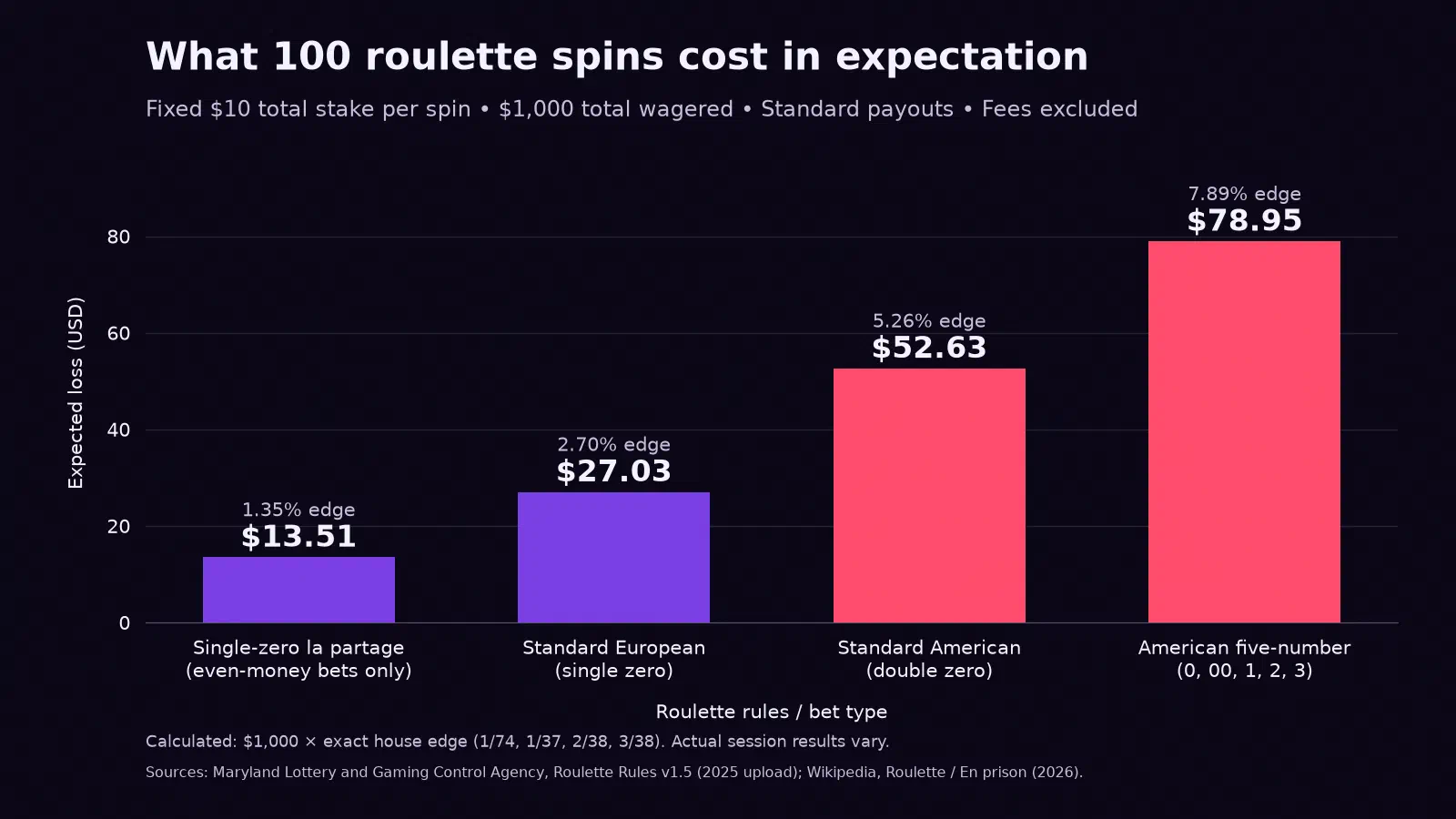
That difference matters even if you never place a complicated bet. A fixed $10 stake over 100 spins produces expected losses of $27.03 and $52.63, respectively, before fees. Your actual result won't follow that neat line. But the rules behind those averages are knowable before you wager.
What changes in european vs american roulette?
Say you open two tables and both pay 1:1 on red. It's tempting to treat them as equivalent. They aren't, because double zero adds a losing outcome without improving that payout.
DefiPlay is a blockchain casino whose European roulette runs on Polygon. Each roulette bet is processed and stored as a public-blockchain transaction, and its random numbers come from Chainlink VRF. That makes the topic more than a choice between wheel pictures: you need to understand both the payout rules and how a result can be checked. The DefiPlay European roulette overview explains the game; here, we'll focus on the wheel's mathematical price.
The Maryland Lottery and Gaming Control Agency's Roulette Standard Rules, version 1.5 (2025 upload), specifies 37 compartments for single-zero roulette and 38 for double-zero. Both include numbers 1 through 36. European adds 0; American adds 0 and 00. Double zero is a separate outcome, not another spelling of zero.
There are still 18 red pockets and 18 black pockets. Neither zero counts as red or black. Under standard full-loss zero rules, a bet on red therefore loses on 19 European outcomes or 20 American outcomes.
The practical check is the game's stated outcome set and settlement rules. A geographic name alone isn't enough. A single-zero wheel with a special zero rule can have a different edge on some bets from a single-zero wheel where zero takes the entire stake.

Why 2.70% and 5.26% are different prices
A red bet looks close to a coin toss. Say you stake $10: a win makes $10 profit, while a loss costs $10. The trouble is that there aren't equally many winning and losing pockets.
House edge means expected loss as a share of the amount wagered. It doesn't mean the casino removes that percentage from every bet. In Milad Haghani's University of Melbourne explanation (2025), the double-zero colour bet wins with probability 47.37% and has a 5.26% edge; the single-zero figure is 2.7%.
Here's the working for a $1 red bet, assuming equally likely pockets and standard payouts:
- European expected net result:
(18/37 × $1) + (19/37 × −$1) = −$1/37. House edge:1/37 × 100 = 2.702702…%. - American expected net result:
(18/38 × $1) + (20/38 × −$1) = −$2/38. House edge:2/38 × 100 = 5.263157…%.
The familiar 2.70% and 5.26% figures are rounded. Calculations below use the fractions, so rounding doesn't creep into the money amounts.
What about betting on one number? Wikipedia's Roulette article (accessed 2026) gives the standard straight-up payout as 35:1 and derives the same edges. The larger prize is balanced by a smaller chance of winning. Standard splits, streets, dozens and colours share the same edge on their respective wheels, apart from special bets or rules.
So choosing red instead of a single number changes how your results fluctuate, not the standard expected loss per dollar. If you want that distinction explained further, our guide to roulette odds covers the bet types without treating a bigger payout as better value.
What 100 spins at $10 actually cost in expectation
Say an adult player in Lisbon budgets for 100 spins, with exactly $10 staked on red each time. Seeing “2.70%” doesn't tell them much about the session until we connect it to total wagers.
The exposure is $10 × 100 = $1,000. Expected loss equals total amount wagered multiplied by house edge. Applying the exact fractions gives:
- Standard European roulette:
$1,000 × 1/37 = $27.03. - Standard American roulette:
$1,000 × 2/38 = $52.63.
The difference is $25.60 in expected loss, rounded after calculation. That's about 48.65% less expected loss on European roulette for identical total wagers. The gap is 2.56 percentage points of house edge, not a 2.56% relative reduction.
Don't confuse wagers with starting funds. You might reuse money returned by winning bets, so $1,000 of turnover doesn't require $1,000 sitting in your wallet at the start. But it does require enough funds to complete the stated sequence; the example assumes all 100 bets happen at the same stake.
And $27.03 isn't a session forecast. Red bets settle in whole wins and losses, so the average can fall between possible individual results. You could finish ahead, lose far more than the expectation, or run out of your budget before the planned final spin.
A usable budget covers losses you can afford, rather than just the average. Expected loss helps compare rules; it can't tell you how much you'll lose tonight. Our house-edge explanation expands on that distinction.
The American five-number bet costs 7.89%
A player worried about zero might put one chip across 0, 00, 1, 2 and 3. It covers both zero pockets, which sounds reassuring. The payout makes it an expensive way to get that coverage.
This is the American five-number bet, also called the top-line bet. Maryland's Roulette Standard Rules (2025 upload), cited above, specifies those five outcomes and a 6:1 payout. A winning $1 stake makes $6 profit; the original dollar is also returned. On the other 33 pockets, the dollar is lost.
Its expected net result is (5/38 × $6) − (33/38 × $1) = −$3/38. That gives a house edge of 3/38 × 100 = 7.894736…%, conventionally written 7.89%. At the same $10 stake over 100 completed bets, expected loss is $78.95.
Compare that with $52.63 for ordinary American bets over the same turnover. Covering the zeros hasn't reduced your mathematical cost. It has raised it through an unfavourable payout.
The useful habit is to check the payout attached to a group of numbers, rather than judging value by how much of the layout your chip touches. You can skip this particular bet without adopting any system. It doesn't improve the odds of your next spin; it avoids a worse-priced wager.
La partage and en prison change what zero takes
Say your $10 red bet lands on zero. Under standard European rules, the whole stake is lost. On a table advertising a French zero rule, the same outcome may cost less—but only for eligible bets.
With la partage, zero returns half an even-money stake. Wikipedia's En prison article (accessed 2026) reports a 1.35% house edge for la partage on those bets. Red/black, odd/even and low/high qualify; a straight-up number bet doesn't gain this protection.
The reason is direct. On a single-zero red bet, 18 winning outcomes and 18 losing black outcomes cancel in expectation. Only zero's half-stake loss remains: 1/37 × 1/2 = 1/74, or 1.351351…%. For 100 separate $10 la partage wagers, expected loss is $13.51 before fees. That's the lower bar in the chart.
With en prison, the stake is held after zero rather than partly returned immediately. If a later resolving spin wins your original selection, you recover the stake without profit. If it loses, the stake is forfeited. Your money may wait longer.
The repeated-zero rule matters. Wikipedia describes several treatments for another zero. If every further zero keeps the original stake imprisoned until red or black resolves it, recovery and forfeiture are equally likely. That version also gives a 1.35% edge per original wager. If a further zero forfeits the stake, the figure is higher.
So “en prison” needs a follow-up question: what happens if zero lands again? It also needs a different counting method from a normal one-spin bet, because one original wager can take several spins to settle. You shouldn't assume DefiPlay offers either rule merely because its game is European roulette.

On-chain verification doesn't change the wheel's odds
Say you can trace a roulette result in a block explorer, but the game uses a double-zero outcome set. The public record can help you examine the result. It doesn't remove the extra losing pocket.
DefiPlay's European implementation uses Chainlink VRF for random numbers and open-source smart contracts to turn them into game results. Each bet is a public transaction. Those features concern checking how randomness and settlement work. The crypto-casino overview explains this transaction-based model, while our provably fair guide discusses what verification can and cannot establish.
DefiPlay implements European roulette. Under the standard single-zero rules compared here, the extra American losing pocket is absent. That's the mathematical benefit of the format. You shouldn't infer a special payout schedule from the presence of blockchain verification, though. The roulette rules and play guide is the relevant place to check game-specific details.
Transaction costs are separate, too. DefiPlay describes gas costs of a few cents per bet; that isn't a fixed fee quote. The chart excludes gas, and it measures dollar stakes rather than assuming a constant dollar price for a crypto token. For a wallet-funded session, budget for transaction costs as well as game losses.
Single zero lowers expected loss, but never makes roulette profitable
Two friends can each win a short session on different wheels. That doesn't make the formats equally priced, any more than one losing European session disproves its lower edge.
The european vs american roulette decision is about rules you can compare before a result exists. With standard payouts and full-loss zero rules, single zero costs less in expectation. La partage can lower the cost further on eligible even-money bets; the American five-number bet moves it in the other direction.
A lower edge still leaves a negative expected return. Changing stake sizes after losses doesn't repair that, and playing extra spins to recover money adds exposure. If your planned budget is gone, the lower-cost wheel isn't a reason to continue. The responsible-gambling guidance helps you set boundaries before that moment.
DefiPlay's European format gives you the single-zero comparison, while public transactions offer a separate way to examine game activity. Keep both questions in view: what are the payout rules, and can you check their execution? Transparency helps you inspect the game. Single zero reduces its standard mathematical cost. Neither promises a winning session.
Frequently asked questions
What is the difference between European and American roulette?
Standard European roulette has 37 pockets: numbers 1 to 36 and one zero. Standard American roulette has 38 pockets because it adds double zero. With standard payouts and full-loss zero rules, their house edges are 2.70% and 5.26%, respectively.
How much do you expect to lose over 100 roulette spins?
At a fixed $10 total stake per spin, 100 spins represent $1,000 wagered. Expected loss is $27.03 on standard European roulette and $52.63 on standard American roulette, before fees. Those are mathematical averages, not predictions of your session result.
Why is the American roulette five-number bet worse?
The bet covers 0, 00, 1, 2 and 3 but pays only 6 to 1 in net winnings. Five winning outcomes and 33 losing outcomes produce a house edge of 3/38, or 7.89%. That exceeds the standard American house edge of 5.26%.
Do la partage and en prison reduce the roulette house edge?
La partage returns half an even-money stake when zero lands on a single-zero wheel, reducing the house edge to 1.35% on those bets. En prison holds the stake for a later result and returns the stake without profit if it wins. Its edge depends on how repeated zeros are settled; continued imprisonment gives 1.35% per original wager.
Does on-chain roulette remove the house edge?
No. Verifiable randomness and public settlement concern how the result is produced and applied. The wheel's possible outcomes and payout rules still determine its house edge.