

A game page displays an audit badge. Your wallet is asking for a signature. Does that badge cover the contract you're about to use, or an older version with different payout rules? A smart contract audit can help you judge security, but the useful evidence sits inside the report. Before risking money, you need to connect that report to the code on the blockchain and understand which assumptions it leaves in place.
What does a smart contract audit actually cover?
A report can review a game contract while leaving its website outside the scope. Say a roulette interface displays one bet, but prepares a transaction for something else. Reviewing the payout contract alone wouldn't establish that the interface sends the right instructions. Scope matters because your experience depends on more than the code that calculates a win.
DefiPlay is a blockchain casino with wallet-based games. Its stated design uses open-source contracts on Polygon and Chainlink VRF for random numbers, with each game action recorded as a public blockchain transaction. That makes the connection between randomness, settlement code and the transaction worth examining. For its European roulette design, the question is how the number becomes a result and then a payment. This article doesn't establish that a particular DefiPlay contract has been audited.
The Ethereum Foundation's ethereum.org security guidance (2026) describes an audit as an independent code review and explicitly warns that audits won't catch every bug. Think of the report as evidence about specified code under specified conditions. You still need to read those conditions.
A useful review can examine access restrictions, accounting and interactions with other contracts. You want its scope to include how bets are accepted, how results are assigned and how payments settle. If the report excludes an external component, check where responsibility for that component starts. Don't assume an audit of the game also reviews your wallet or guarantees the operator's legal status.
Read the report's scope before its badge
An impressive cover page can hide a version mismatch. Say the reviewed repository contains the original roulette payout code, while the website now points to an implementation with a new cancellation function. The old report may still be genuine. It doesn't answer the new question.
Start with the report's scope and code identifiers. Look for the repository, files and commit hash: the fingerprint of a particular version in version control. If the report lists deployed addresses, compare both the address and network with the game you intend to use. The same-looking address on another network isn't enough.
Then read the exclusions and assumptions. Does the review assume an administrator acts honestly? Does it rely on an external randomness service without reviewing that service? Those statements identify where your trust remains. They aren't automatically defects, but they change what the audit supports.
Finding status deserves more attention than the headline count. A report might label an issue fixed, acknowledged or unresolved; use that report's definitions. “Acknowledged” can mean the team accepts the risk rather than changing the code. Severity labels also need context. Read the described impact and conditions instead of assuming that “medium” always means tolerable.
For a fix, look for evidence that the reviewer checked the correction, and identify the corrected version. A proposed patch doesn't prove that the deployed game includes it. You don't need to understand every code listing to ask a precise question: “Where is the reviewed fix in the contract this transaction uses?”
Match the report to verified code on a block explorer
A public repository can contain readable code that isn't running at your transaction's destination. For example, a game might link to a source folder while the wallet prepares a call to a different address. The practical answer is to start from the transaction details, then work back to the report.
You can inspect an address and published source without signing a transaction. For an existing game transaction, open its details from your wallet and check the network and destination. If that destination is a router or proxy, follow the documented call path to the game logic rather than stopping at the first address. A pending wallet request can also show a destination; approving it isn't a prerequisite for checking it.
The Ethereum Foundation's source-verification documentation (2026) explains that verification compares compiled published source with blockchain code. A verified label supports that correspondence. It doesn't certify the code's security, and comments alone don't establish what a function does.
In the explorer's contract area, look for published source and verification details. Compare the files and compilation information with the report's reviewed version. If the explorer identifies a proxy, inspect its current implementation too. The proxy's source may explain forwarding calls without containing the payout logic you're trying to assess.
Read-only contract views can help expose current values, such as an owner address or a pause setting, if the contract provides them. Labels vary between explorers. There's no need to use a write-function panel or connect your wallet just to read public data. If the code-to-report match remains unclear, ask for documentation through the help center.

Reentrancy can interrupt payout accounting
A payout can trigger another contract's code before the game finishes updating its records. Imagine a settlement function sends a win first and marks the bet paid afterwards. If a recipient contract can call back during that gap, vulnerable logic may process the same claim again.
That's reentrancy: a callback enters the contract before the original action has finished. Wikipedia's account of The DAO attack on 17 June 2016 reports the transfer of 3.6 million ether through an attack combining vulnerabilities, including recursive calls. That historical amount shouldn't be confused with a present-day dollar valuation or a permanent-loss figure.
The Ethereum Foundation's 2026 security guidance explains the checks-effects-interactions pattern: validate the action, update the records, then make the external call. It also describes reentrancy guards that block certain callbacks during execution. These measures address the timing problem, though their correct use still needs review.
As a player, look for discussion of settlement and external calls in the report. Does it cover repeat claims and interactions between payout functions? A reassuring word in a code comment isn't enough. You want the reviewer to have considered the paths that touch the same accounting, because guarding one function doesn't explain every interaction.
Randomness needs safe handling throughout the bet
A random result can arrive with valid proof and still be handled badly by the game. Say a contract allows someone to change a bet after its random value becomes known, or request a replacement result after an unfavourable outcome. The proof wouldn't establish that the game kept its promises about when choices were fixed.
Blockchain-derived randomness also deserves care. Kalinin and Ryan's EIP-4399 (2021) documents predictability and bias risks for Ethereum's PREVRANDAO randomness, including a proposer delaying a dice transaction so it uses a known value. That's an Ethereum-specific example, not a description of Polygon's consensus. It shows why “comes from the blockchain” isn't a sufficient security argument.
For a game using an external randomness service, ask how each request is tied to its original bet. The report should explain who may deliver the response, when choices become final and whether settlement can happen more than once. You also want a documented response to delays. An unexplained fallback to a different random source changes the assumptions you're judging.
DefiPlay describes using Chainlink VRF. Our separate guide to Chainlink VRF explains that component; the provably fair verification guide covers checking results. Here, focus on the integration. Evidence about a random number doesn't replace a review of the contract that assigns and pays the outcome.
Admin keys can change the rules you reviewed
A contract can be verified and reviewed while still granting someone permission to change its behaviour. Say its administrator can replace the payout implementation. Your report may describe yesterday's logic perfectly, while future bets use different code at the same proxy address.
Palladino, Giordano and Croubois's ERC-1967 standard (2019) describes proxies that delegate execution to a separate implementation while retaining storage and balances. It standardizes locations for implementation information and an optional administrator address, helping explorers display those details. Not every upgrade system uses an administrator slot, so an empty slot alone doesn't prove that upgrades are impossible.
You want a plain-language account of who can upgrade, pause, change parameters or move contract funds. Separate intended powers from access-control bugs. An authorized administrator changing a setting may be using a documented permission rather than exploiting a vulnerability. Either way, that power affects your decision.
The Ethereum Foundation's upgrade guidance (2025) discusses multisignature control and enforced timelocks. Multiple approvals can reduce dependence on one signer; a timelock delays an approved change. But a delay can also slow an urgent patch. Check the actual permissions and enforced delay rather than relying on a governance label, and don't assume multisignature signers are independent people.
Correct payout code can still have a house edge
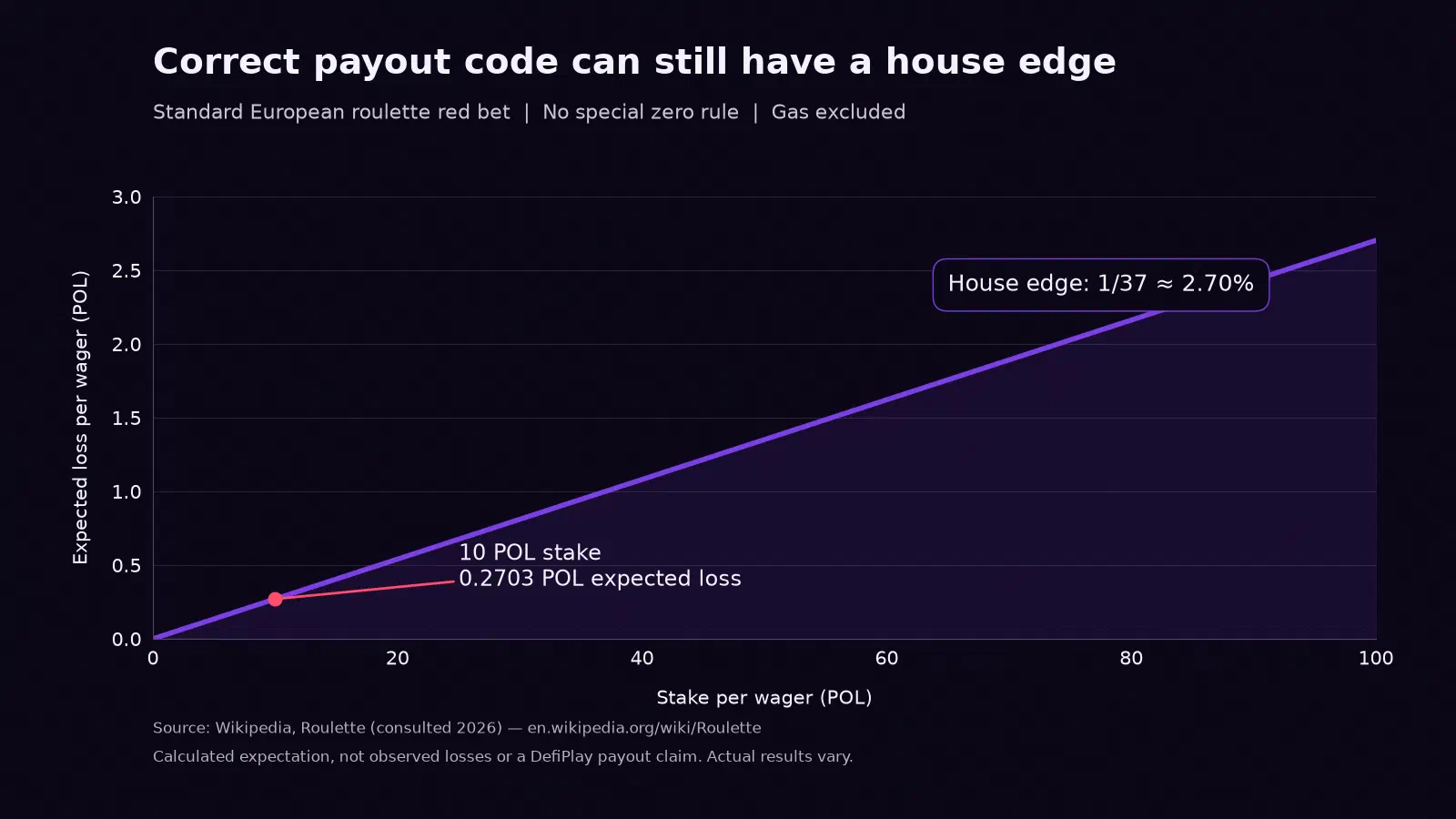
A security report can find that payouts follow the stated rules without making those rules favourable to you. Say an adult player in Lisbon considers a 10 POL bet on red in a hypothetical standard European roulette game. This example isn't a claim about DefiPlay's payout configuration.
Wikipedia's roulette reference, consulted in 2026, describes a single-zero wheel with 37 pockets, including 18 red outcomes, and a red bet paying 1:1 profit, with the stake also returned on a win. Assume equally likely pockets, no special zero rule and no gas fees. There are 19 losing outcomes: black or zero.
The expected net result is:
(18/37 × 10 POL) + (19/37 × −10 POL) = −10/37 POL ≈ −0.2703 POL.
Relative to the stake, the expected loss is 1/37 ≈ 2.70%. That average isn't a prediction for your next bet. The chart shows this same mathematical expectation at different stakes, not observed player losses.
The audit question is whether settlement implements the promised payout. The spending question is whether you're willing to lose the wager. For more on that distinction, see how house edge works. Set a loss limit you can afford; responsible gambling guidance belongs beside security checks, not after losses.
A short checklist before trusting a game contract
A report can be long enough that you stop checking and accept the badge. Say you're reading it on your phone while a wallet request waits in another app. A short checklist keeps the decision tied to evidence rather than pressure to finish.
- Match the destination. Check the network, transaction destination and game-contract path. This helps you avoid assessing an unrelated address.
- Match the reviewed version. Compare the deployed code, any proxy implementation and the report's final reviewed version. A genuine report can still cover different code.
- Read unresolved findings. Look at impact, assumptions and fix verification. A finding count alone doesn't tell you which risks remain.
- Trace randomness and settlement. Look for fixed bets, authorized responses and protection against repeat settlement. These connect proof of randomness to actual payments.
- Identify administrative powers. Establish who can change logic or interrupt play. That tells you whose future actions you're relying on.
- Check your exposure. Read the transaction and any token permissions it requests, and keep the stake within your loss limit. Public code doesn't make a signature harmless.
These checks don't turn you into an auditor. They help you spot missing evidence and ask useful questions. If a material gap remains, you can leave the request unsigned.
Trust the audit only after matching it to the contract
An old report can remain online after an upgrade, leaving you with persuasive evidence about the wrong version. A smart contract audit earns its place in your decision when you can connect its scope and reviewed fixes to the deployed game, including its current implementation and administrative powers.
You don't have to resolve every technical question yourself. You do need a clear explanation of the unanswered ones. If you can't establish which reviewed code will handle your bet, there's no reason to rush the signature.
Frequently asked questions
Does a smart contract audit mean a blockchain game is safe?
An audit provides an independent review of specified code, but it cannot guarantee that every vulnerability was found. You still need to check that the report covers the deployed version and understand its unresolved findings and administrator permissions. A security review also does not remove gambling losses or the house edge.
Is a verified contract the same as an audited contract?
No. Source verification checks that published source code compiles to the code associated with a blockchain address. An audit examines security within an agreed scope; verified code can still contain bugs or risky permissions.
What should I look for in a game contract audit report?
Start with the scope, reviewed code version, exclusions and finding statuses. Then check the deployed contract and any current implementation behind a proxy. Pay particular attention to payout handling, randomness integration and who can change the game.
Sources
- Ethereum Foundation, Smart contract security, 2026 documentation
- Ethereum Foundation, Verifying smart contracts, 2026 documentation
- Wikipedia, The DAO, account of the 2016 attack
- Kalinin and Ryan, EIP-4399, 2021
- Palladino, Giordano and Croubois, ERC-1967, 2019
- Ethereum Foundation, Upgrading smart contracts, 2025
- Wikipedia, Roulette, consulted 2026