

A ten-cent bet can carry a separate network charge, and your wallet may show a maximum fee that looks larger than the final bill. That's why polygon gas fees deserve a quick calculation before you sign. The useful questions are how much computation the transaction needs, what each unit costs, and how that fee compares with your stake.
This guide covers Polygon PoS, the network used for DefiPlay's on-chain games. The worked example uses stated assumptions, not a live gas quote or a measured DefiPlay transaction. Your wallet estimate and the confirmed receipt give you the figures for your own transaction.
Why every on-chain game action has a separate cost
A slot spin looks like a button press. In an on-chain game, it can also be an instruction that a blockchain must process. DefiPlay is a blockchain casino using smart contracts: each roulette bet and slot spin is processed and stored as a public blockchain transaction on Polygon.
That makes the fee relevant to the rhythm of play. DefiPlay's European roulette implementation takes game actions from a player's own wallet, rather than a deposited casino balance. A stake and a network charge serve different purposes, so they belong on separate lines in your budget.
Older screens may say MATIC. Wikipedia's Polygon entry (2026) identifies POL as the native token and MATIC as its previous name. For a normal transaction you pay yourself on Polygon PoS, you need native POL for gas. A balance on another network doesn't pay this bill. Our guide to adding Polygon to MetaMask covers network setup.
How polygon gas fees are priced
A quote of 100 gwei doesn't tell you the whole transaction cost. It's a price per unit of computation, like a rate rather than a finished invoice. A contract call that uses more gas costs more at the same rate.
The Ethereum Foundation's gas documentation (2026) defines gas as computational effort and gives the relationship: gas fee equals gas used multiplied by the price per gas. It also defines one gwei as one billion wei, or one-billionth of ETH on Ethereum. Polygon uses the corresponding native-token denomination: one gwei is 0.000000001 POL when quoting its gas price.
Polygon PoS uses an EIP-1559-style fee model. Gontara, Boufaied and Korbaa's conference paper (2023) studies that fee change on Polygon as well as Ethereum. The precise fee fields come from Buterin and colleagues' EIP-1559 specification (2019):
- Base fee: the protocol-set price per gas for the block. Its adjustment responds to earlier block usage relative to a gas target.
- Priority fee: a tip per gas for the block producer. Your transaction specifies its maximum tip.
- Maximum fee per gas: the ceiling covering the base fee and tip together. It isn't an extra charge.
For an eligible EIP-1559 transaction, the effective gas price is the smaller of base fee plus maximum priority fee and maximum fee per gas. The base fee takes precedence; the tip can shrink if the cap leaves less room. If your cap is below the block's base fee, the transaction can't be included in that block.
The gas limit is a different control. It caps computation units, not the unit price. EIP-1559 specifies a 21,000-gas starting intrinsic cost before extra transaction data and execution work. Don't use that plain-transfer figure as a game-contract estimate. The contract's operations determine the extra work.
A worked game-transaction cost in POL and dollars
Say you want to price a hypothetical game-contract call before approving it. Your wallet's maximum estimate looks higher than the fee you expected. The answer is to separate the ceiling from the assumed final usage.
Use these illustrative inputs: 200,000 gas used, a 70-gwei base fee, a 30-gwei maximum priority fee, and a 150-gwei maximum fee per gas. Assume a gas limit of 250,000 and a POL price of $0.50. These are teaching assumptions, not current market data, recommended fee settings, or measurements of DefiPlay's contracts.
Here is the working:
- Effective price: min(70 + 30, 150) = 100 gwei per gas.
- Network fee: 200,000 × 100 = 20,000,000 gwei.
- Native-token fee: 20,000,000 ÷ 1,000,000,000 = 0.020 POL.
- Dollar equivalent: 0.020 × $0.50 = $0.010, or one cent.
The transaction's gas-fee ceiling is different: 250,000 × 150 ÷ 1,000,000,000 = 0.0375 POL. That ceiling excludes the stake. Under the assumed execution above, the actual charge remains 0.020 POL because the transaction uses less than its gas limit and pays less than its per-unit cap.
You'd need enough native POL to cover the permitted gas cost, plus any POL value sent with the transaction. EIP-1559's 2019 specification requires that affordability check. The unused allowance isn't an additional final fee.
After confirmation, the receipt supplies gas used and effective gas price. Those figures let you check the charge. For dollars, choose a clearly stated conversion price; a dollar estimate can change even when the fee in POL doesn't.
Why the same action can suddenly cost more
Yesterday's quote doesn't reserve today's price. Say you return to the same game and the contract call hasn't changed, but your wallet shows a higher network charge. The unit price may have risen even if the gas required is similar.
EIP-1559's 2019 specification increases the base fee when earlier block gas usage exceeds the target and decreases it when usage falls below it. Competition for inclusion can also raise priority-fee bids. You can't lower the protocol's base fee by editing a wallet field; you can cap what you're prepared to pay or wait.
There is no dependable universal “cheap hour.” Demand can arrive from other applications on the same network. A scheduled event isn't required, and your own small transaction doesn't receive a special low rate because the stake is small.
Fee reform also doesn't promise permanently cheap execution. Liu and colleagues' ACM CCS study (2022) found easier fee estimation but no reduction in the overall fee level during its Ethereum observation period. That isn't a Polygon price benchmark. It explains why a better pricing mechanism should not be mistaken for a fixed-cost guarantee.
If the updated quote breaches your budget, postponing an optional transaction avoids accepting that price. Waiting may help; it doesn't guarantee the next quote will be lower.
How to set a fee in MetaMask without guessing
A wallet presents a fee estimate, and it's tempting to drag every setting down. For example, reducing the gas limit may make a maximum estimate look cheaper while leaving the contract unable to finish. The useful adjustment is usually the price you're willing to pay, not an arbitrary reduction in computation.
In MetaMask, review the transaction confirmation and open its gas-fee editing control if you need to change the estimate. Labels and available options vary by version and network, so follow the controls your wallet actually displays. The MetaMask installation guide covers getting started; this section concerns the transaction fee review.
A practical sequence is:
- Check the selected network and native POL balance. Confirm the intended contract or recipient and the stake before considering gas. A cheaper fee doesn't make a wrong transaction safe.
- Review the suggested fee and maximum cost. For an optional game action, paying extra for priority deserves a reason. A faster submission isn't a better bet.
- If advanced EIP-1559 fields are available, distinguish the caps. Maximum priority fee controls the tip ceiling. Maximum fee per gas covers base fee plus tip. A cap too close to the current base fee leaves little room for a rise before inclusion.
- Keep a credible gas-limit estimate. Reducing it doesn't reduce the work the contract needs. Review the final maximum gas cost alongside the stake before signing.
The Ethereum Foundation's transaction documentation (2026) lists these separate fields: gas limit, maximum priority fee per gas, and maximum fee per gas. They explain what you're authorizing even if the wallet groups them into one estimate.
Don't copy the worked example's gwei inputs into your wallet as a universal setting. The right cap depends on the current network and your own spending ceiling. If the quote is unclear, declining to sign is a reasonable choice. Our self-custody wallet guide explains why that approval remains your responsibility.
A pending or failed transaction needs a status check
A spin appears stuck, so you click again. That can make the situation harder to diagnose, especially if you're unsure whether the first instruction was submitted. The practical answer starts with the transaction status, not another bet.
Open the wallet's transaction details and check the transaction hash in an explorer. Pending, confirmed successfully, and confirmed unsuccessfully describe different states. The Ethereum Foundation's 2026 transaction documentation defines the nonce as a sequential account counter; pending transactions can affect the ordering of later ones from that account.
If your wallet offers a replacement or speed-up control, review its new fee ceiling and understand which pending transaction it replaces. Don't assume a second ordinary submission cancels the first. If the first transaction is already confirmed, a fee edit can't undo it.
An unsuccessful execution can still cost gas. The Ethereum Foundation's 2026 gas documentation distinguishes rejection before inclusion, which consumes no execution gas, from running out of gas during execution, which consumes the supplied gas and reverts changes. Other execution failures can charge for work performed too. Paying gas buys computation, not a successful game result.
Small stakes make gas a larger share of your spending
One cent feels negligible until the stake is ten cents. In the worked example, the gas charge is 10% of that stake before any gambling outcome. That's the comparison that makes polygon gas fees meaningful for small bets.
Using the same assumed one-cent transaction fee, gas is 4% of a $0.25 stake, 1% of a $1 stake, and 0.2% of a $5 stake. Each percentage is calculated as gas cost divided by stake, multiplied by 100. The chart shows those exact results; it isn't a record of observed network prices.
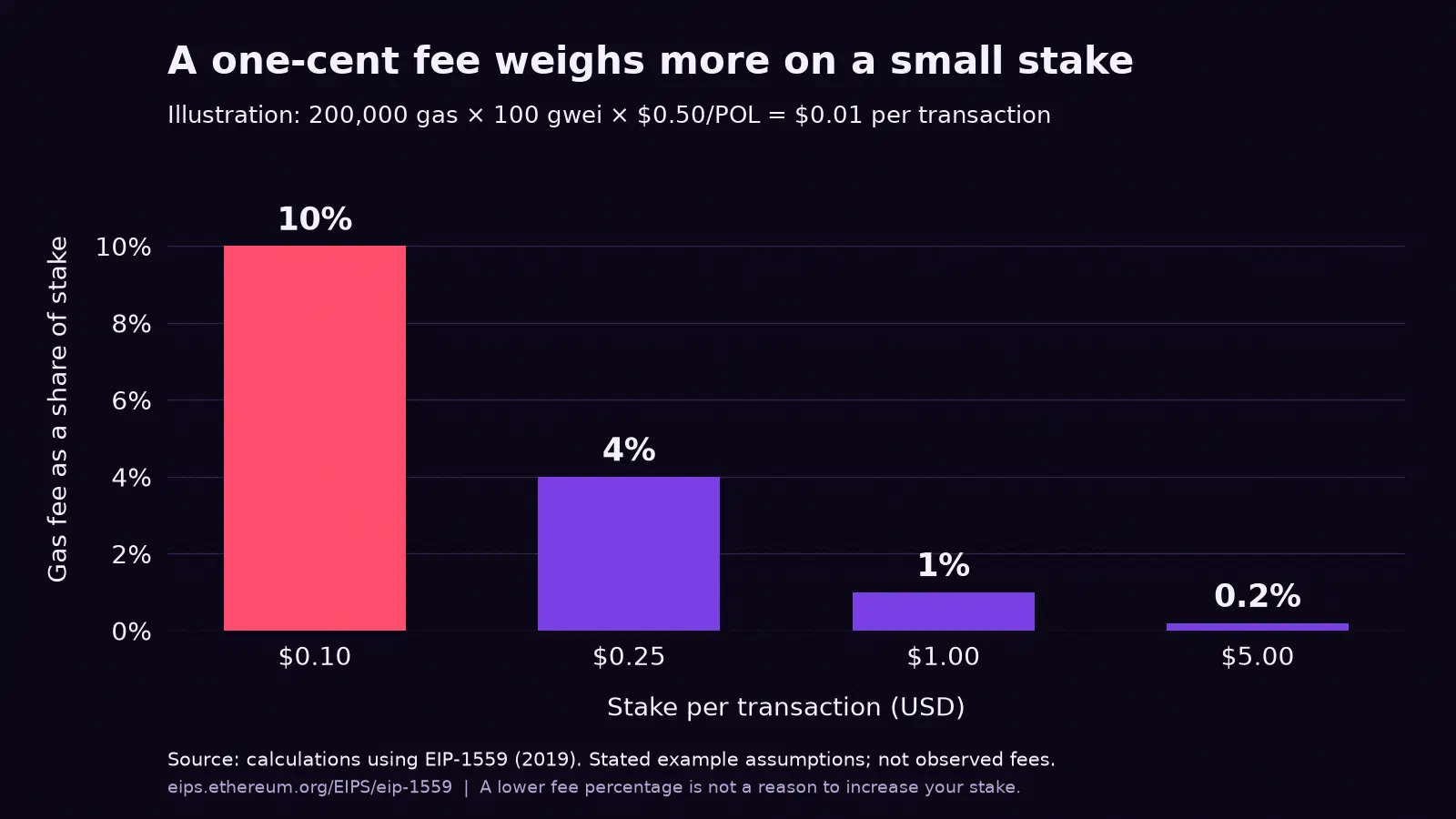
A lower percentage at a larger stake isn't a reason to raise your bet. You'd expose more money to gambling losses to make the fee look smaller. Gas doesn't alter the game's probabilities, and it sits outside the house edge explained here.
A session budget also needs the repeated charges. Under the same fixed assumptions, 20 transactions cost $0.20 in gas, regardless of their game outcomes. If a game flow asks for separate paid approvals or other transactions, include those charges too rather than treating one receipt as the entire session cost.

Budget for gas before signing, rather than increasing your stake
A player sets a spending limit, then treats each tiny gas charge as outside it. That creates an avoidable blind spot: the wallet pays the network charges as well as any gambling losses. Your budget should account for both.
Before signing, compare the expected fee and the wallet's maximum fee with the stake and your remaining spending allowance. After confirmation, use the receipt to check the actual charge. That routine turns polygon gas fees into a cost you can evaluate instead of an unexplained deduction.
No particular gas percentage makes a bet profitable. If the fee feels excessive, you can pause or skip the transaction without increasing the stake. Set limits you can afford to lose, including network charges, and use our responsible gambling guidance if play is becoming difficult to control. A smaller gas bill cannot remove the risk of losing the stake.
Frequently asked questions
Do I need POL or MATIC to pay gas on Polygon?
Polygon PoS uses POL as its native gas token. Older guides and wallet labels may still say MATIC. Check the selected network and your native-token balance rather than relying on the ticker alone.
How do I calculate a Polygon transaction fee?
Multiply gas used by the effective price per gas. For an EIP-1559 transaction, that price is the base fee plus the paid priority fee, limited by your maximum fee per gas. Divide a result expressed in gwei by one billion to get POL, then multiply by your assumed POL dollar price.
Is the maximum gas fee what I will actually pay?
No. The maximum fee per gas is a ceiling, while the gas limit caps the amount of computation. The final fee depends on gas actually used and the effective gas price when your transaction is included.
Can a failed transaction still cost gas?
Yes, if it was included in a block and executed unsuccessfully. Computation already performed still costs gas, even though the contract changes revert. A transaction rejected before inclusion does not incur an execution gas fee.
Sources
- Wikipedia, Polygon blockchain entry, 2026
- Gontara, Boufaied and Korbaa, Impact of EIP-1559 on Transactions in the Ethereum Blockchain and Its Rollups, 2023
- Buterin et al., EIP-1559 fee market specification, 2019
- Ethereum Foundation, Gas and fees documentation, 2026
- Ethereum Foundation, Transactions documentation, 2026
- Liu et al., Empirical Analysis of EIP-1559, ACM CCS, 2022