
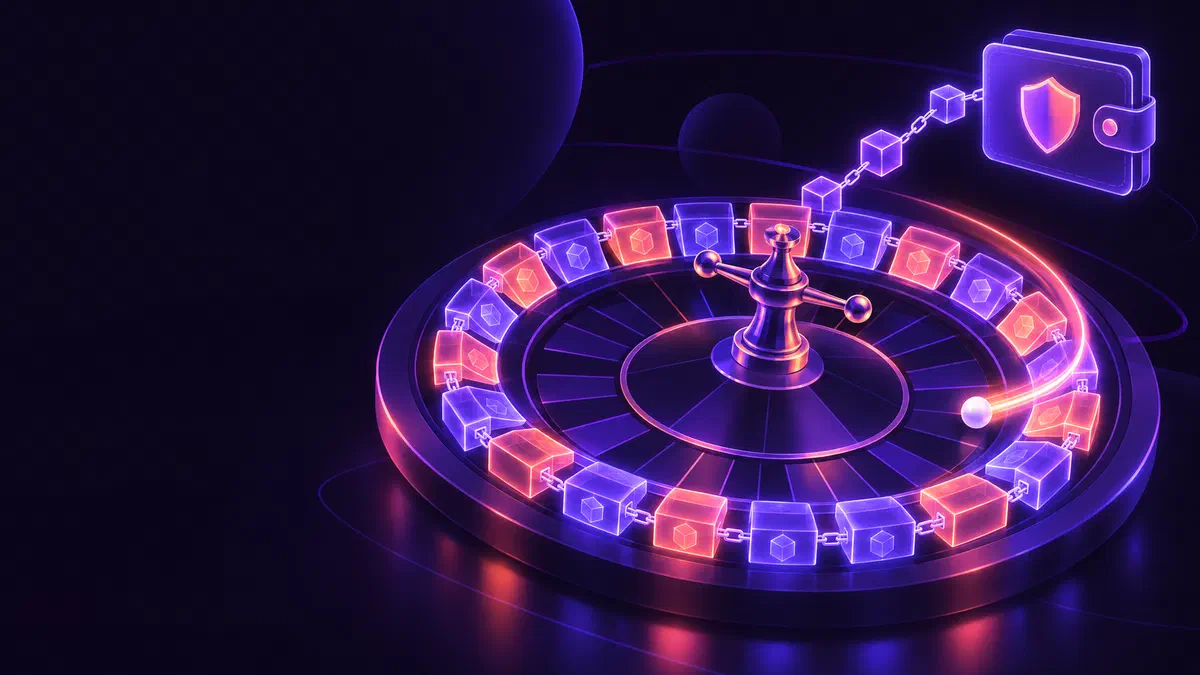





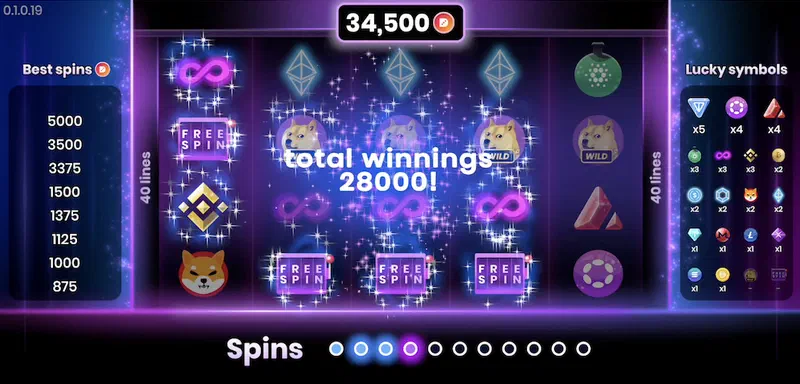
What makes a blockchain casino different from an online casino?
Most online casinos ask for two leaps of faith. You hand over your money as a deposit, and you accept results from a random number generator you can't see. Say a player in Austin deposits $200, wins $350 over a weekend and then waits five working days while a withdrawal request sits in "pending". The game may well have been fair, but nothing in the process lets the player prove it.
A blockchain casino removes both leaps. The game logic lives in a smart contract, a program stored on a public blockchain that executes exactly as written. Your stake moves from your wallet only when you sign the transaction, and the payout comes back to the same address. So the question changes from "do I trust this operator?" to "does this code do what it says?", and the second question has an answer anyone can look up.
How a DefiPlay bet works, step by step
DefiPlay is a blockchain casino on Polygon with two games: crypto roulette, built on the single-zero European wheel, and crypto slots. Both follow the same four steps, and knowing them helps you read your own transactions later.
- You connect a wallet. Your address is your account. There's no sign-up form, because the blockchain already knows who signed each transaction. Our MetaMask installation guide covers the setup in about ten minutes.
- You sign the bet. The wallet shows the stake and the gas fee before you confirm. Nothing leaves your wallet without that signature.
- The contract requests a random number. It asks Chainlink VRF, a verifiable random function oracle, for a number and a cryptographic proof that the number wasn't tampered with.
- The contract settles. It checks the proof, turns the number into a pocket or a reel position, and pays any win to your wallet. On Polygon this takes about 6 seconds for a transaction, and a slot round settles in about 5-10 seconds.
The practical benefit is that every step leaves a record. If a result ever looks wrong, you don't open a support ticket and wait. You open the transaction.
How to check a blockchain casino before you play
Plenty of sites call themselves a blockchain casino while running ordinary server-side games and only using crypto for payments. That's a crypto-friendly casino, which is a different thing (the label costs nothing, the architecture does). Four checks separate the two, and each takes a few minutes:
- Where does the money sit? If you have to send coins to a casino address and wait for a balance to appear, the operator holds your funds. In a true blockchain casino your balance stays in your wallet.
- Can you find the bet on-chain? Every bet should have its own transaction hash. If only deposits and withdrawals appear on the chain, the games themselves are off-chain.
- Is the random number verifiable? Look for a named randomness source with a proof, such as a VRF. Our guide to provably fair games explains what a proper proof looks like.
- Is the contract source published and verified? A verified contract on a block explorer lets you match the deployed code with the published code. Our article on smart contract audits shows what to read first.
These checks work because each one tests the architecture, not the marketing. A site can promise fairness in any words it likes, but it can't fake a transaction hash.
Blockchain doesn't change the odds
A transparent casino is still a casino. On a European wheel with 37 pockets the house edge is 1/37, or 2.70%, whether the wheel spins in Monte Carlo or in a smart contract. What the blockchain changes is your ability to confirm that the advertised odds are the real odds. We think that's the right deal for players: honest maths you can verify, rather than a promise of better luck. Our explainer on the house edge shows how that 2.70% adds up over a session, and our responsible gambling page covers the limits worth setting before you start.
Frequently asked questions
What is a blockchain casino?
A blockchain casino runs its games as smart contracts on a public blockchain. Each bet is a transaction the player signs from their own wallet, the random number comes from a verifiable source, and the result is recorded on-chain where anyone can check it.
Do I need to deposit money to play at DefiPlay?
No. DefiPlay has no deposits and no withdrawals. You play straight from your own crypto wallet, each bet leaves your wallet only when you sign it, and wins are sent back to the same wallet by the smart contract.
Which blockchain does DefiPlay use?
DefiPlay runs on Polygon, an Ethereum-compatible network. A transaction takes about 6 seconds on average and the gas fee is a few cents per bet. The network's native token, used to pay gas, is POL (formerly MATIC).
How can I check that a game result was fair?
Open the bet transaction in your wallet or a block explorer. The logs show the random number delivered by Chainlink VRF, and the open-source smart contract shows exactly how that number was turned into your result.
From the blog

Smart contract audit: read the report before you play
An audit badge is a starting point. Learn how to check the report, follow verified game code, and spot risks in payouts, randomness and upgrade permissions.
Polygon Gas Fees: What Each On-Chain Bet Really Costs
A gas quote looks small until you compare it with your stake. Learn the fee formula, a worked POL-to-dollar example, and which wallet settings control the bill.
Add Polygon to MetaMask: A Safe Polygon PoS Setup
Set up Polygon PoS in MetaMask with verified network settings, spot misleading RPC requests, and keep native POL available for transaction fees.