

A roulette animation stops, but your wallet shows a transaction that finished earlier. Which record actually proves the result? If you searched for “chainlink vrf” to answer that question, the useful starting point is a trail from the bet to the randomness request, then to its fulfilment and the game's settlement.
Those records answer different questions. A successful bet transaction can establish that your request was accepted. It doesn't, by itself, establish that the random output arrived or that the game used it correctly.
DefiPlay is a blockchain casino built around wallet transactions. Its games run on Polygon, and its stated approach uses Chainlink VRF for random numbers alongside open-source game contracts. That makes DefiPlay's European roulette a useful context for this explanation: you want to check both where the randomness came from and how the contract turned it into a pocket. The examples below are illustrative, not claims about a particular deployed contract or service version.
What does “chainlink vrf” prove about your result?
A random-looking number isn't evidence of fair generation. Say a player in Lisbon sees a long hexadecimal value beside a losing round. An operator could display a long value regardless of how it chose the outcome. The useful question is whether that value has a proof tied to a previously fixed input and public key.
Silvio Micali, Michael Rabin and Salil Vadhan introduced verifiable random functions in their 1999 paper, Verifiable Random Functions. Their construction lets a secret-key holder evaluate a function and prove the result without revealing how to predict its outputs at other, unproved inputs.1
A VRF is a keyed, deterministic function. Once its key and input are fixed, its output is fixed too. To someone without the secret key, an unrevealed output should look pseudorandom under the scheme's security assumptions. “Pseudorandom” means computationally indistinguishable from random in the relevant security setting; it doesn't mean a physical source was measured.
The Crypto Forum Research Group's 2023 RFC 9381 describes a prover that uses the secret key and input to produce a proof. A verifier uses the public key, that same input and the proof to return either a valid output or an invalid result. Its uniqueness property rules out accepting two different outputs for the same fixed key and input.2
That qualification matters. A VRF doesn't stop someone changing inputs or choosing among requests if the surrounding application permits it. Nor does it hide the output from the key holder. The practical protection depends on fixing the relevant request before the result can be used to change the bet.

You don't need to learn elliptic-curve arithmetic to make this distinction. The broader guide to provably fair games covers the surrounding fairness claim. Here, the narrower question is whether the particular random output has a valid, request-bound proof.
Why your bet and its random result arrive separately
Your wallet can say “confirmed” while the game is waiting. For example, a slot request might already be recorded even though the result screen hasn't changed. Treating wallet confirmation as completion hides the application's intermediate state.
The Ethereum Foundation's oracle documentation describes a request-response pattern: an on-chain contract receives a request, an off-chain node processes it, and a later transaction delivers a response through a callback. A callback is a function the oracle system calls on the requesting contract. The same documentation identifies Chainlink VRF as an example of off-chain random generation accompanied by on-chain cryptographic proof verification.3
In a typical game integration, the bet transaction records the player's choice and triggers a randomness request. The request has an identifier that the game can associate with the pending round. An oracle produces the output and proof; a later fulfilment transaction submits the response for verification and delivery to the game.
The game then applies its outcome rule. It may settle during that callback, or record the output for a separate settlement step. Your task is to follow the contract's actual path rather than assume every integration follows the same sequence.
These stages explain why there needn't be a second wallet signature from you when the oracle responds. The response is another actor's transaction, not another bet. Don't sign a new wager just because the animation is taking longer than expected: that may create another round rather than complete the existing one.
The guide to blockchain games explains why actions become public records. For a randomness check, the extra step is joining those records through the request identifier and the game's stored round information, rather than matching them only by time.
What can you check in a transaction's logs?
A block explorer can show several events in one receipt, and their names can look equally convincing. Say a transaction contains a “result” event: its name alone doesn't prove it came from the intended oracle or that it belongs to your bet.
Start with the transaction your wallet submitted. Confirm the network and destination contract, then inspect its receipt. The Ethereum Foundation's JSON-RPC documentation distinguishes the transaction hash from the receipt, which contains the block hash, block number and logs. Pending transactions don't yet have that receipt.4
For the request, look for the link between your round and the oracle request. Depending on the contract, this may appear in decoded events, stored state, or both. Record the emitting contract address as well as the identifier. An event emitted by the game and an event emitted by an oracle contract are different pieces of evidence, even if an explorer displays them together.
Then find the later fulfilment for that request. Don't assume an oracle's fulfilment event prints the complete random output or proof. The output may instead be recorded in the game's storage or its own event, while proof material appears in the fulfilment transaction's input. Event fields and decoding depend on the implementation and its application binary interface, or ABI: the description that turns encoded bytes into named parameters.
A practical check has four parts:
- Request linkage: the pending round points to the request you're following.
- Contract identity: the request and response involve the addresses the game code actually uses.
- Delivery: the response reached the game's intended callback and the round's state changed as expected.
- Settlement: the recorded result and payment follow the game's rules for that round.
Receipt status is a useful first filter, but it isn't a fairness verdict. Nick Johnson's 2017 EIP-658 specifies 1 for top-level success and 0 for failure.5 A successful outer transaction doesn't automatically establish every condition you care about inside the game. You still need the relevant events and state.
Reading an explorer means relying on its presentation and data provider. Stronger verification uses independently obtained chain data and the actual verifier code to check the proof, public key and request input. Most players won't do that cryptographic replay themselves. They can still avoid a common mistake: treating a screenshot of a random number as equivalent to a verified request-to-result trail.
A valid random output still needs a correct pocket mapping
A proof can pass while the game's conversion rule is wrong. Imagine a toy program that receives a uniformly random integer and uses the remainder after division to pick a roulette pocket. The number's origin and the mapping's probability distribution are separate checks.
New Jersey's single-zero equipment rule, reproduced by Cornell's Legal Information Institute, specifies 37 compartments, labelled zero and 1 through 36.8 We'll use those 37 labels in a deliberately small example. This is exact arithmetic, not measured DefiPlay data.
Suppose the toy source has 256 equally likely values, from 0 to 255, and the program computes pocket = value % 37. The % operator returns the remainder. Here is the working:
256 = 6 × 37 + 34
Each pocket gets six source values, but the first 34 pockets get an extra one. Pockets 0–33 therefore each have probability 7/256 = 2.734375%; pockets 34–36 each have probability 6/256 = 2.34375%.
If the rule instead rejects values 222–255 and draws again from the same uniform source, the remaining 222 = 6 × 37 values give every pocket exactly six possible inputs. Each pocket's probability becomes 6/222 = 1/37, approximately 2.702703%.
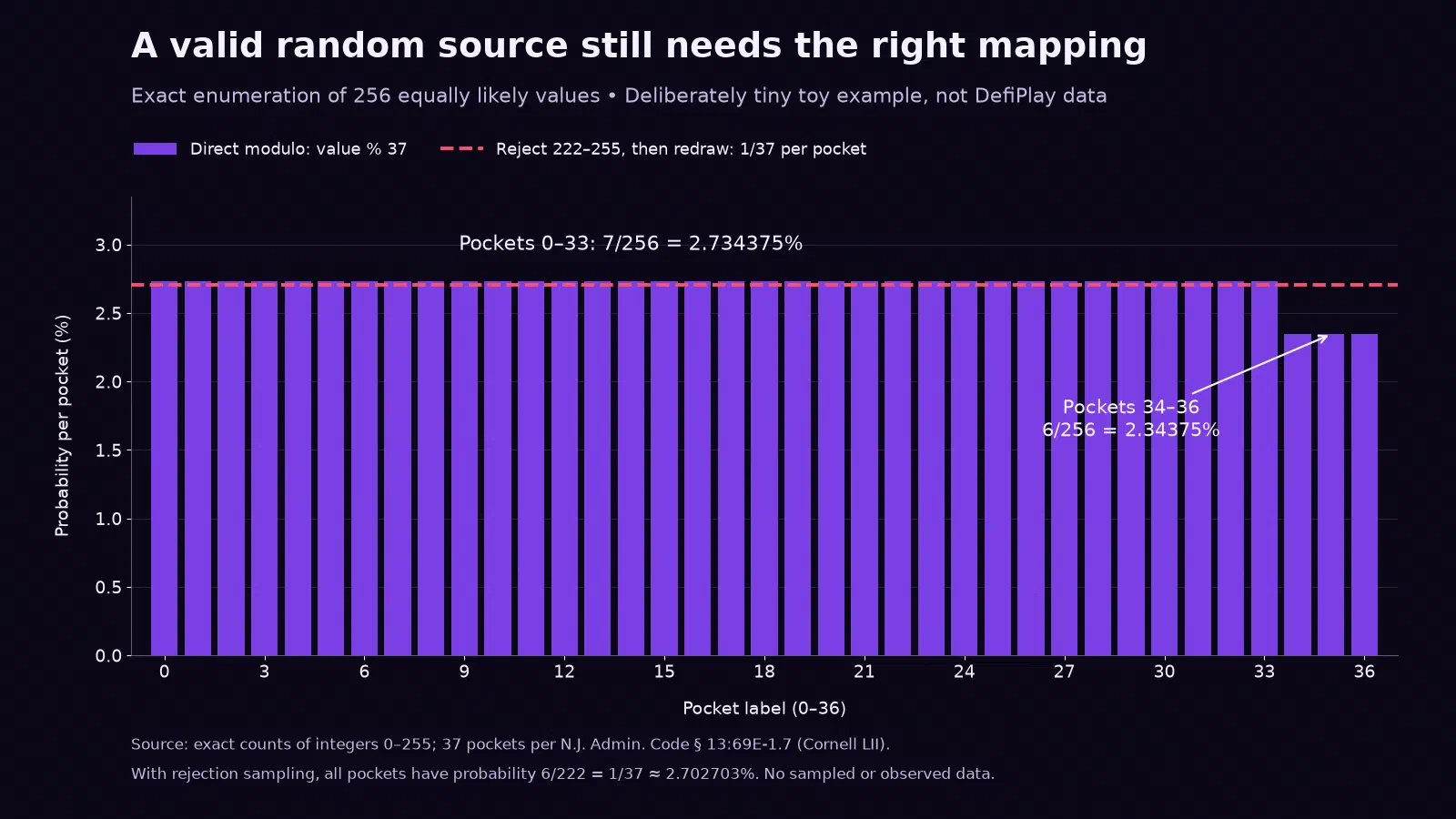
The chart exaggerates the issue by using a tiny source so you can see it. It doesn't show the size of any bias in a deployed VRF integration, and it doesn't establish which mapping DefiPlay uses. A much larger source can make remainder imbalance extremely small. A specific implementation needs its own calculation.
There's also a difference between a pre-agreed sampling algorithm and an operator choosing to discard a losing or winning round. Any extra draws must follow fixed rules; discretionary rerolls would defeat the point of binding a bet to its request.
For you, the useful question is: “Where does the contract turn the delivered value into the displayed outcome?” That's a focused code-review question. The guide to smart contract audits explains the wider review, including payment logic and privileged controls.
Confirmations trade waiting time for protection against rewrites
A short delay can feel like the game has stalled. Suppose your request is visible, but fulfilment hasn't appeared. Before interpreting that gap, distinguish the oracle's confirmation policy from the time needed to generate, submit and include its response.
Shuo Zhang and colleagues' study, published in December 2025 with a January 2026 version of record, explicitly describes a time difference caused by Chainlink's block-confirmation requirement. Their vehicle-network system requests randomness in advance to account for that delay.7 That is evidence of the mechanism, not a benchmark for casino response times.
Confirmations matter because recent chain history can change. Micah Zoltu's 2017 EIP-234 explains how a chain reorganisation can remove logs and replace the block at a particular height. It proposes identifying logs by block hash so clients can distinguish the actual block they queried.6
In a blockchain-bound randomness design, rewriting the relevant request history can change its input. VRF uniqueness applies to a fixed key and input; it doesn't promise identical outputs for different inputs. Waiting for enough confirmations helps protect against that history-changing route to another result.
There's no universal confirmation count that this article can safely prescribe for every network, game and stake. A defensible choice depends on the network's security and the value exposed. More waiting can improve protection, but it costs responsiveness. And a confirmation threshold isn't the same thing as a guarantee of finality.

Keep the original transaction hash if you're checking a delay. It helps you tell whether the request is pending, recorded without a response, or fulfilled without completed settlement. If the records are unclear, the help center is a better next step than another bet. An oracle also needs to respond: proof verification can't force timely delivery from an unavailable service.
Verify the entire round, not just the randomness label
A losing round with valid randomness can still be a correctly executed losing round. For example, the contract can use its output exactly as specified while the payout schedule gives the house an advantage. A proof isn't a promise of profit.
The useful standard for a “chainlink vrf” claim is a linked, inspectable record: the bet was fixed, the matching request received a verified response, and the game used that response according to its published code. Where any link is missing, say which question remains unanswered instead of calling the whole round verified.
That standard also keeps expectations realistic. Randomness verification doesn't certify a game's legal status or remove gambling risk. Set limits you can afford and use the responsible gambling guidance before risking funds.
Your strongest player-level check ends at the settlement rule. A valid proof explains the output's origin; the contract explains what happened to your bet.
References
Frequently asked questions
What is Chainlink VRF?
Chainlink VRF is an oracle service that supplies smart contracts with random values backed by cryptographic proofs. A verifier checks the proof before the application consumes the values. The game still needs correct code to turn those values into outcomes and payouts.
Can I verify a casino's VRF result in a block explorer?
You can follow the game's randomness request to its later fulfilment and check the emitting contract addresses and request identifier. Depending on the implementation, the output may be available in contract storage or game events rather than in an oracle event. Independently checking the cryptographic proof requires the correct verifier, public key and request input.
Why does a VRF request take time to finish?
The request and its response happen through separate on-chain transactions with off-chain work between them. Confirmation requirements and transaction inclusion add delay. A confirmed request does not mean that the game has received its random result or completed settlement.
Does a VRF proof make a casino game profitable?
No. The proof concerns the random output, not the game's payout schedule or your chance of making money. A correctly implemented game can still have a house edge, and you can still lose your stake.
Sources
- Micali, Rabin and Vadhan, Verifiable Random Functions, 1999
- IRTF Crypto Forum Research Group, RFC 9381, 2023
- Ethereum Foundation, Oracles, undated documentation
- Ethereum Foundation, JSON-RPC API, undated documentation
- Nick Johnson, EIP-658, 2017
- Micah Zoltu, EIP-234, 2017
- Zhang and colleagues, Adaptive rateless coded blockchain for dynamic IoV scenarios, published 2025; version of record 2026
- New Jersey Administrative Code 13:69E-1.7, Cornell Legal Information Institute, undated