

A jackpot symbol stops just above the winning line. It feels close enough to suggest that another spin might finish the job. But the screen doesn't tell you how that symbol was selected, or whether it had the same chance as the blank beside it.
The useful answer to “how do slot machines work” follows the result behind the animation: a random input selects an outcome, the game's rules decide what it pays, and the interface shows you what happened. Understanding those separate jobs helps you read a paytable without mistaking a dramatic moment for better odds.
So, how do slot machines work behind the reels?
A cabinet with a handle can look mechanical even when software chooses its result. The handle and spinning drums don't tell you which system you're dealing with. Early mechanical slots used physical reels and payout mechanisms; electronic slots can retain physical reels while a computer selects their stopping positions.
Turner and Horbay's 2004 peer-reviewed explanation describes both physical-reel electronic slots and video slots with simulated reels.1 In the software-driven case, a random number generator, or RNG, supplies inputs. Game logic maps those inputs to reel stops or other outcomes, evaluates the winning combinations, and awards the corresponding payout. The spinning display presents that result; watching it won't reveal the hidden selection probabilities.
DefiPlay is a blockchain casino whose described Crypto Slots implementation runs on Polygon. DefiPlay says each spin is recorded as a public blockchain transaction, randomness comes from Chainlink VRF, and its smart contracts are open source. That adds an inspectable record behind the reels. The wallet-based crypto casino model concerns how you interact with the game; the symbol probabilities still need their own explanation.
Virtual reels make some symbols rarer than they look
A prize symbol might occupy the same amount of screen space as a cherry, yet appear on the winning line much less often. Counting the pictures you see therefore isn't a reliable way to calculate the odds. The missing information is the mapping between random inputs and displayed symbols.
A virtual reel is a software selection space. In one common electronic-reel design, several equally likely virtual stops point to the same physical stop. That physical stop then has a greater selection probability than a stop with fewer entries pointing to it. This is weighting. The input can be uniformly random while the displayed symbols have unequal probabilities.
Harrigan and Dixon's 2009 study gives a concrete example from an Ontario game's design documents: 72 virtual stops map to 22 physical stops. One blank receives three virtual entries, a neighboring prize symbol receives one, and another blank receives five. Their respective probabilities on that reel are 3/72, 1/72 and 5/72.2 The visible reel alone doesn't show those differences.
Video slots can instead select positions on software reel strips directly. Repeated symbols on a strip affect their frequency without needing a separate physical-reel mapping. Designs vary; neither method means every visible cell is a separate random draw.
For you, the practical consequence is straightforward: a symbol hovering above the payline isn't evidence that a jackpot is becoming more likely. Its appearance may reflect the reel layout and weighting. A near miss remains a losing outcome.

A paytable decides whether matching symbols actually pay
Three bells look like a win, but they might sit across a line you didn't bet on. Or a bright animation might celebrate a payout smaller than your total stake. The pictures need to be read alongside the rules.
A payline specifies which symbol positions are evaluated together. Other games use ways-to-win or scatter rules rather than a single line. Wild symbols can substitute for other symbols, but their exceptions depend on the game. A scatter may pay or trigger a feature without following an ordinary payline. Turner and Horbay's 2004 paper describes the different wager options and bonus features available in video slots.1
The useful check is the total stake and the applicable payout rule, rather than the largest prize printed on the screen. If you stake $1 and receive $0.40, your net result is a $0.60 loss, whatever sound the interface plays. That's an illustrative transaction, not a reported DefiPlay payout.
Bonus features also belong in the mathematics. A different reel set during a rule-defined bonus doesn't mean the game is adjusting your personal luck. It means you're evaluating a different, specified game state.
RTP is an average calculated across possible outcomes
A listed return to player of 90% can sound like a promise to return $90 from your $100. It isn't. RTP is the theoretical average payout relative to stakes, calculated from the probabilities and payouts of the game. It doesn't set the result of your session.
The Gambling Commission's 2020 explanation uses a simplified game with three reels of 20 positions each, one winning line and a £0.50 stake. Each reel has two copies of each paying symbol, plus blanks. Three bars pay £250, three stars £75, three bells £45, and each matching triple of melon, orange, lemon or cherry pays £20.3
Here's the working:
- There are 20 × 20 × 20 = 8,000 equally likely stop combinations.
- Each matching triple has 2 × 2 × 2 = 8 combinations, giving 8/8,000 = 1/1,000 probability per triple.
- Adding the payouts across the complete outcome space gives 8 × (£250 + £75 + £45 + £20 + £20 + £20 + £20) = £3,600.
- The corresponding stakes total 8,000 × £0.50 = £4,000, so RTP = £3,600 / £4,000 = 90%.
This enumerates possibilities. It doesn't predict that each combination will appear once in your next 8,000 spins. The Commission explicitly warns against that reading.3
The same source replaces one blank on the third reel with another cherry. Cherry combinations become 2 × 2 × 3 = 12. The four extra £20 outcomes add £80, making theoretical RTP £3,680 / £4,000 = 92%. The RNG can stay random throughout; changing the reel design changes the expected payout.
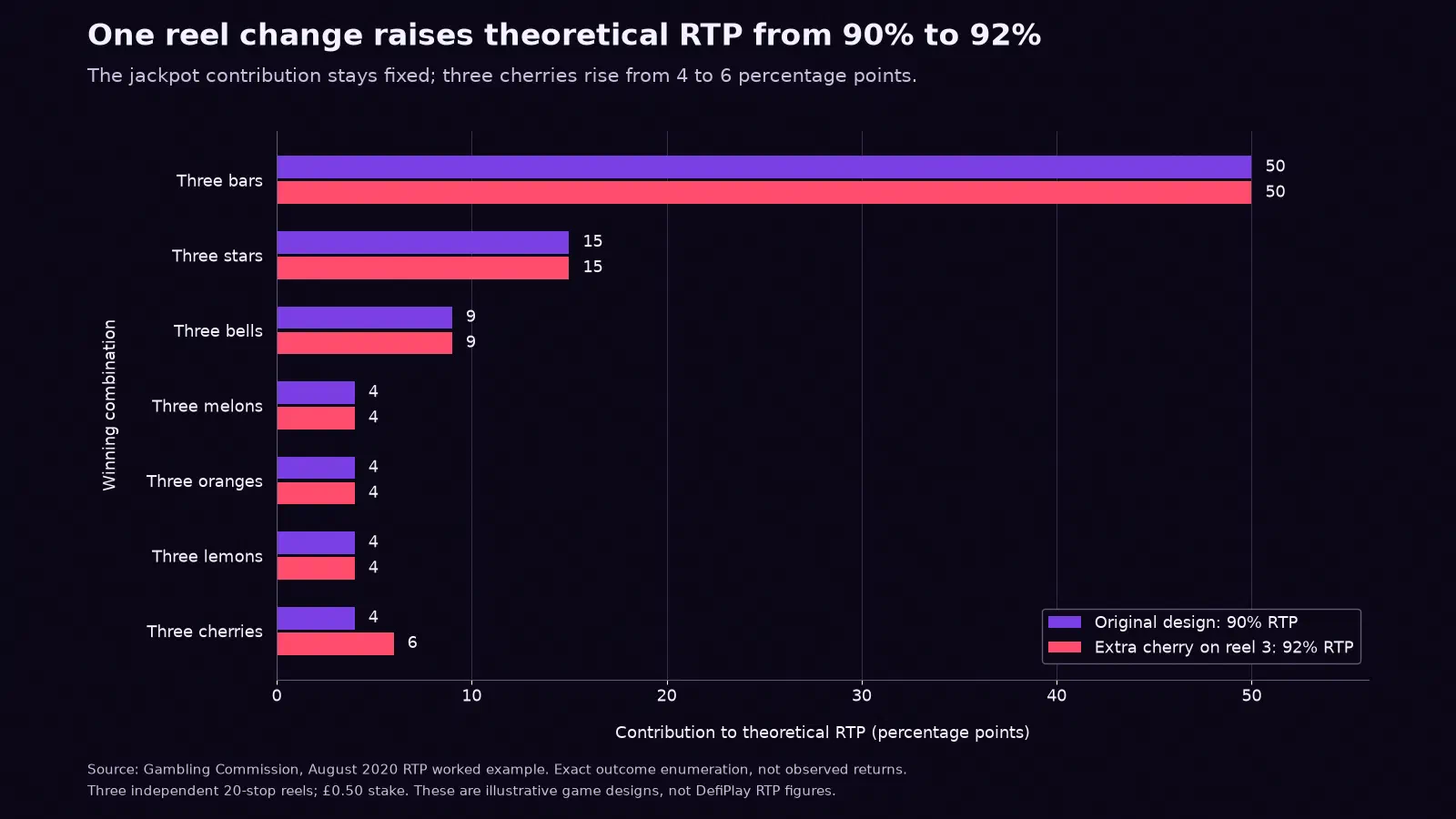
These are the regulator's teaching examples, not DefiPlay RTP figures. The related house edge explanation covers how expected losses follow from a game's return.
Volatility explains why the same RTP can feel different
Two games can advertise the same RTP while giving you very different sessions. One might return money through frequent smaller payouts; another might allocate more of its expected return to rare, large prizes. A shared average doesn't imply a shared experience.
Volatility describes the spread of possible returns. Harrigan and Dixon's 2009 paper explains that a higher volatility index corresponds to greater variation in session payback percentages.2 RTP concerns the average; volatility concerns how widely results can differ around it.
The chart makes that distinction tangible. In the regulator's original example, the bar jackpot contributes 50 percentage points of the 90% RTP, despite its 1/1,000 probability. Much of the expected return sits in an infrequent event. You shouldn't expect a short session to resemble the theoretical average.
Hit frequency answers another question: how often a game awards something. It doesn't tell you how often the payout exceeds your total stake. A frequent small award can still be a net loss.
For a fixed-probability game with independent spins, a losing streak doesn't improve the next spin's odds. A larger budget changes how much you can lose and how long you might play; it doesn't erase the house edge. Keeping a loss limit separate from any hoped-for bonus prevents a statistical average from becoming a reason to chase losses.
Regulated RNG testing checks the number and the game
A “random” label is incomplete evidence. An RNG could produce good-looking numbers while the software maps them to symbols incorrectly. Testing has to examine both layers.
The Gambling Commission's 2021 RTS 7, updated in 2024, distinguishes uniform RNG output from game outcomes distributed according to their theoretical probabilities. It also prohibits adaptive, compensated behavior in the remote games to which it applies.4 That's why unequal symbol probabilities aren't automatically a fault, but changing your odds to react to recent losses would be a different issue.
Its 2021 testing procedure, updated in 2024, requires approved test houses to review RNG documentation, investigate known algorithm weaknesses, examine source code, and statistically test raw and scaled output. Game testing separately checks the mathematics, displayed rules, theoretical RTP and the mapping into outcomes.5 Simulated play tests returns; emulation checks rare events; manual testing checks the player-facing implementation.
A certificate therefore needs a scope. The Commission's procedure calls for game details including RTP, software number and digital signature, along with the platform version and tests applied.5 The meaningful question is whether the evidence matches the particular game and software version you're examining.
These are examples of a regulator's requirements, not statements about DefiPlay's licensing or certification. Nor does a statistical test alone establish that an implementation has no security defects.
An on-chain slot turns a verified number into symbols
A block explorer can show you a long random value without explaining why the screen displayed a cherry. The missing step is deterministic game logic: the published rules that turn that value into an outcome.
The Ethereum Foundation's oracle documentation, which is undated, describes how external computation can provide randomness and a cryptographic proof to a blockchain.7 The Crypto Forum Research Group's 2023 RFC 9381 explains the general VRF mechanism: a secret-key holder computes an output and proof, and a verifier uses the public key to check them.6 This explains the cryptographic idea, rather than specifying DefiPlay's exact integration.
A well-specified on-chain slot can fix the wager and relevant rules before randomness arrives, associate the response with that wager, and apply its mapping and paytable. The provably fair explanation covers what verification establishes; here, the important part is the mapping after verification.
Consider a small teaching design with three reels, each having 16 stops. It takes a uniformly distributed value R from 0 to 4,095, representing 16³ = 4,096 possible stop combinations. Splitting that value into base-16 digits selects a stop for each reel.
For R = 3,159, the stops are 7, 5 and 12, because 3,159 = 7 + 5 × 16 + 12 × 256. This exact range makes every stop combination equally likely. It's an illustrative mapping, not a description of DefiPlay's deployed reel strips or contract.
Suppose those fixed strips show blank/star/cherry around stop 7, cherry/bell/blank around stop 5, and bar/cherry/bell around stop 12. The displayed matrix would be:
Top:     blank   cherry   bar
Middle:  star    bell     cherry
Bottom:  cherry  blank    bell
The machine selected three stops. The surrounding strip positions supplied the other visible symbols; it didn't make nine independent selections. The paytable then decides what the matrix pays.
For arbitrary reel lengths, reducing a random value with a remainder operation can introduce bias if the input range doesn't divide evenly. That conversion needs examination too. A valid randomness proof doesn't certify the symbol weights, payout code or settlement behavior. Those checks belong with the smart contract audit discussion.

Verify the payout rule before trusting the spinning display
You can inspect a random input and still misunderstand the price of a spin. For example, a verified cherry result doesn't tell you whether the payout covered your stake, or whether most expected returns depend on a rare prize.
The practical answer to “how do slot machines work” lives in the combination of selection probabilities, payout rules and the record connecting them. A useful assessment checks the actual RTP and total wager, treats volatility as a risk to your session budget, and asks what the available verification evidence covers.
DefiPlay's described public transactions and open-source contracts make that connection part of the story behind its slots. They don't turn a randomness proof into favorable odds. If you need help understanding an interface or transaction, the help center is the relevant starting point. A separate, affordable loss limit remains necessary; the responsible gambling guidance explains that boundary. No animation or verification method can make gambling money you can't afford to lose a sound decision.
Frequently asked questions
Are slot machine results really random?
A fully random slot uses random inputs to select outcomes according to fixed game probabilities. Symbols can have different selection probabilities even when the random inputs are uniform. Some land-based compensated machines work differently, so the machine type and applicable rules matter.
Does 90% RTP mean I get 90% of my money back?
No. A theoretical RTP of 90% describes the expected return across the game's possible outcomes and a very large amount of play. Your session can finish far above or below that figure, and it can end with your entire gambling budget lost.
Can a slot machine be due for a win?
In a fixed-probability game with independent spins, previous losses don't improve the next spin's chances. A near miss doesn't change those chances either. Rule-defined bonus features or persistent game states need to be understood separately; they don't establish a betting system that beats the house.
Does a verifiable random function prove a slot has good odds?
A VRF proof lets a verifier check a random output against its input and public key under the system's cryptographic assumptions. It doesn't establish the slot's RTP or confirm that the outcome mapping and payout code are correct. Those rules require separate examination.
Sources
- Turner and Horbay, How do slot machines and other electronic gambling machines actually work?, 2004
- Harrigan and Dixon, PAR Sheets, probabilities, and slot machine play, 2009
- Gambling Commission, How can gaming machines meet their RTP if they are random?, 2020
- Gambling Commission, RTS 7: Generation of random outcomes, 2021; updated 2024
- Gambling Commission, Procedure for testing, 2021; updated 2024
- Crypto Forum Research Group, RFC 9381: Verifiable Random Functions, 2023
- Ethereum Foundation, Oracles developer documentation, undated